



The Most Important Points in 30 Seconds
- A real estate UG is not a separate legal form, but rather a UG (haftungsbeschränkt) whose business purpose is primarily focused on acquiring, holding, renting out, or managing real estate.
- A UG is a corporation and is generally subject to corporate income tax and trade tax. However, companies that exclusively manage and use their own real estate may, subject to the statutory requirements, qualify for the extended trade tax reduction under Section 9 No. 1 Sentence 2 et seq. of the German Trade Tax Act (GewStG).
- The statutory share capital of a UG can be less than €25,000. It must be paid in full upon formation; contributions in kind are not permitted when establishing a UG. In practice, extremely low share capital is often impractical for real estate transactions.
- The formation process is generally the same as for any other UG: define the business purpose and articles of association, complete notarization, open a business bank account, pay in the share capital, register with the Commercial Register, and subsequently complete tax registration.
- A real estate UG does not automatically provide tax advantages. Key factors include the real estate strategy, financing, holding period, ongoing income, planned sales, and whether profits remain within the company or are distributed to shareholders.
- Set up a real estate UG: Once the business purpose and planned real estate structure have been determined, you can set up your UG digitally with beglaubigt.de and prepare the formation process from the documents through to Commercial Register registration.
What Is a Real Estate UG?
A real estate UG is an Unternehmergesellschaft (haftungsbeschränkt), or entrepreneurial company with limited liability, used for real estate activities. It can, for example, acquire, hold, rent out, and manage real estate, provided these activities are covered by the company's stated business purpose.
Legally, it is not a special type of real estate company but a regular UG governed by the German Limited Liability Companies Act (GmbHG). The term “real estate” merely describes the company's business purpose. The same basic corporate-law requirements therefore apply as to other UGs.
The structure can be particularly interesting for founders who want to build a real estate portfolio within a limited-liability corporation. Whether this actually results in tax advantages, however, depends on the company's specific activities and tax structure.
Have you determined that a real estate UG fits your plans? Then you can start setting up your UG digitally with beglaubigt.de and prepare the next steps, from the formation documents through to Commercial Register registration.

Setting Up a Real Estate UG – Advantages of a Real Estate UG
The decision to establish a real estate UG (Unternehmergesellschaft) offers a variety of advantages, particularly due to tax incentives and flexibility under corporate law. A detailed look at Germany's tax and corporate-law framework illustrates why a real estate UG can be attractive to entrepreneurs and investors.
Tax advantages:
- Income tax aspects: Profits from renting and leasing real estate are treated as rental and leasing income under Section 21 of the German Income Tax Act (EStG). Under certain circumstances, this income may benefit from allowances that directly reduce the tax burden. A real estate UG can significantly reduce its taxable income through depreciation of real estate (AfA), i.e. the depreciation of buildings over time. One example is straight-line depreciation for residential buildings, which is generally 2% per year.
- VAT option: When real estate is sold, it may be possible under certain conditions to opt for VAT, which can be particularly advantageous when selling to other businesses entitled to deduct input VAT. This can make the property more attractive to the buyer and potentially increase its sale value.
- Trade tax: A real estate UG that exclusively manages assets and is not considered to conduct a commercial business may, under certain circumstances, be exempt from trade tax. This depends on the specific structure of its business activities. The distinction from commercial activity is crucial, as commercial income is subject to trade tax.
Flexibility under corporate law:
- Limited liability: Like a GmbH, the UG (haftungsbeschränkt) offers the advantage of limiting liability to the company's assets. This is particularly relevant for real estate investments, where the financial risk can be considerable. Shareholders are therefore protected against personal liability for the company's obligations.
- Low share capital: Compared with a GmbH, a UG can be established with minimum share capital of just €1. This makes establishing a real estate UG attractive even for smaller investors or start-ups in the real estate sector.
- Flexible corporate management: The UG allows flexible management and organizational structures. This makes it possible to tailor the company to the specific requirements of the real estate market and its investors.
Practical example:
Suppose a real estate UG purchases an apartment building for €500,000 and uses straight-line depreciation of 2% per year. This results in annual depreciation of €10,000, which can be deducted from rental and leasing income, thereby effectively reducing the UG's tax burden. In addition, if the property is sold after renovation work, it may be possible under certain conditions to opt for VAT in order to increase the sale value.
What Business Purpose Is Suitable for a Real Estate UG?
The company's business purpose should describe as precisely as possible which real estate activities the UG actually intends to carry out. Depending on the business model, these may include, for example, acquiring, holding, managing, and renting out the company's own real estate.
Particular caution is required if the company intends to claim the extended trade tax reduction. Additional activities can affect whether the requirements for this tax benefit are met. The business purpose should therefore not only be sufficiently specific from a corporate-law perspective but should also be aligned with the planned tax model.
One possible wording for a company focused exclusively on its own real estate portfolio could include the “acquisition, holding, management, and rental of its own real estate.” However, the exact wording should always match the actual business model and should be reviewed before formation in tax-sensitive structures.
What Taxes Does a Real Estate UG Pay?
For tax purposes, a real estate UG is generally treated like other corporations. The decisive factor is therefore not simply whether the company owns or rents out real estate, but what income it generates, what additional activities it carries out, and how profits are subsequently used. The frequently stated claim that an asset-managing real estate UG pays a flat tax rate of only 15.83% is therefore an oversimplification.
Corporate Income Tax
A UG is generally subject to corporate income tax on its taxable profit. The solidarity surcharge is also levied on corporate income tax. At company level, business expenses and—where the statutory requirements are met—depreciation on buildings can reduce taxable profit.
However, what subsequently happens to the profit is also relevant to the actual overall tax burden. If the profit remains within the company and is used, for example, for further investments, the situation differs from a distribution to shareholders, which may result in additional taxation at shareholder level.
Trade Tax and the Extended Reduction
As a corporation, a UG is generally deemed to operate a commercial business and is therefore also subject to trade tax. For real estate companies, however, the extended reduction for real estate companies under Section 9 No. 1 Sentence 2 et seq. GewStG can be particularly relevant.
Subject to the statutory requirements, this may reduce the portion of trade income attributable to the management and use of the company's own real estate. However, the requirements are strict. In particular, additional activities carried out by the company may affect whether the benefit can be claimed.
It should therefore be determined before formation which activities the real estate UG will actually perform and how its business purpose should be worded. The extended reduction should not be equated with a general “trade tax exemption for real estate UGs.”
VAT
VAT treatment also depends on the specific activity. The rental of real estate is generally treated differently for VAT purposes than, for example, certain commercial rental services or real estate transactions. Under certain circumstances, it may also be possible to opt for VAT.
Particularly where purchases, rentals, and subsequent sales are planned, the VAT consequences of the specific business model should therefore be assessed in advance.
Distributions to Shareholders
Taxation does not necessarily end at the level of the real estate UG. If profits are distributed to shareholders, additional taxes may arise at shareholder level. A reliable comparison between privately owned real estate and a real estate company therefore cannot be made simply by comparing the UG's corporate income tax rate with the personal income tax rate of a private property owner.
Whether a real estate UG offers tax advantages instead depends on the overall structure—particularly the holding period, financing, ongoing income, planned sales, additional activities, and whether profits are distributed or reinvested within the company over the long term.
Real Estate UG: How to Take Advantage of the 15.83% Tax Rate
As a corporation, a real estate UG benefits from a comparatively low income tax rate: it pays just 15% corporate income tax plus a 5.5% solidarity surcharge, resulting in an effective tax rate of 15.83%. This taxation applies to profits—for example, rental income or proceeds from sales after costs have been deducted.
Compared with the top personal income tax rate of up to 45% for privately rented real estate, this can result in significant tax savings—particularly for investors with higher incomes or growing real estate portfolios.
Another potential tax advantage relates to trade tax: real estate UGs that exclusively engage in asset management are not considered commercial businesses for the purposes of trade tax law. According to Section 9 No. 1 Sentence 2 GewStG, trade tax does not apply to income from the “management and use of the company's own real estate.” It is important that the UG does not actively engage in commercial activities, such as extensive property-development activities or short-term rentals with additional services.
Conclusion: Anyone who operates a real estate UG solely for asset management can secure an effective overall tax rate of just 15.83% on an ongoing basis—a significant lever for long-term wealth creation through real estate.
Establishing a Real Estate UG: What Steps Are Required?
The formation of a real estate UG takes place in several steps:
- Selecting the shareholders: First, the shareholders of the real estate UG must be determined. These can be natural persons or legal entities. It is important that all shareholders are of legal age and have full legal capacity. They are listed in the shareholder list.
- Drafting the articles of association: The articles of association form the fundamental legal framework of the real estate UG and set out key provisions such as the composition of shareholders, distribution of profits and losses, management of the company, and termination of the company. It is advisable to have the articles of association prepared by a lawyer.
- Registration in the Commercial Register: The real estate UG must be registered with the competent local court. Various documents must be submitted for this purpose, including the notarized articles of association, a declaration regarding the shareholders' legal capacity, a declaration regarding the adequacy of the share capital, a shareholder list, and an extract from the shareholders' civil status register. (beglaubigt.de now offers this process entirely remotely and digitally; learn more here: Commercial Register registration).
- Opening a business bank account: After registration in the Commercial Register, a business bank account must be opened for the real estate UG. All business transactions are processed through this account.
- Applying for a tax number and VAT ID: A tax number must be obtained from the tax office for the real estate UG. If the real estate UG is subject to VAT, a VAT identification number is also required.
- Taking out insurance: It is advisable to obtain appropriate insurance coverage for the real estate UG to protect against risks. This may include, for example, business liability insurance or professional liability insurance.
What requirements apply when setting up a UG, and how can you avoid common mistakes? Our guide to legally compliant steps and costs provides clear recommendations for completing the registration correctly.
How Much Does It Cost to Set Up a Real Estate UG?
The formation costs of a real estate UG generally do not differ from those of any other UG (haftungsbeschränkt).
To establish a real estate UG, share capital of at least €1 is initially required. However, choosing higher share capital is advisable because a UG often generates little or no profit during its first few years, and the share capital serves as a liability reserve.
In addition to the share capital, formation costs such as notary fees and Commercial Register registration fees must be taken into account. The exact costs can vary depending on the amount of work involved and the location and should therefore be determined individually.
Ongoing costs for the real estate UG should also be considered, such as rent for office or business premises, employee salaries, and insurance premiums.
Our guide “Setting Up a UG: Requirements, Costs, and Legally Compliant Steps for Company Formation” explains in detail how the general costs of setting up a UG are structured and what additional requirements must be met.
Tax Optimization Through Loss Offsetting for Real Estate UGs (2026)
The corporate income tax rate for an asset-managing UG—like other corporations—remains 15% plus a 5.5% solidarity surcharge, resulting in an effective rate of 15.825%. However, the loss-offsetting rules under Sections 10d and 8 KStG can make the structure particularly interesting from a tax perspective.
Under certain conditions, losses arising from the management, renovation, or sale of real estate can be offset against profits in subsequent years. This can enable a real estate UG, particularly during its initial phase, to invest specifically in renovations or measures designed to increase property values without immediately incurring a tax burden.
Important: Loss carryforwards can be fully offset up to €1 million. Above this amount, minimum taxation applies, meaning that no more than 60% of profits exceeding this threshold can be offset. The period currently available for utilizing these losses is up to ten years.
Recognition always requires active entrepreneurial activity in the field of real estate management. Pure investment companies that generate exclusively passive income do not benefit to the same extent.
This rule also makes the real estate UG an effective instrument for tax-optimized investing in 2025—particularly for long-term wealth accumulation.
Comparing the Tax Burden: Real Estate UG vs. Private Purchase
Example 1: Purchasing real estate through a real estate UG
- A real estate UG is established by a person who owns private real estate and would like to rent out properties in order to benefit from tax advantages.
- The real estate UG purchases an apartment for €200,000.
- The real estate UG rents the apartment to tenants and generates rental income of €1,000 per month.
- The real estate UG pays corporate income tax (KSt) of 15% plus a solidarity surcharge of 5.5% on the rental income, resulting in a tax rate of 15.83%.
- The real estate UG therefore pays corporate income tax of €183.30 per month.
Example 2: Purchasing real estate privately
- A person already owns private real estate and wants to purchase another apartment for €200,000.
- The person rents the apartment to tenants and receives rental income of €1,000 per month.
- The person must pay tax on the rental income at their personal income tax rate, which can be as high as 45%.
- The person therefore pays €450 in income tax per month.
In this example, purchasing the property through a real estate UG would be more advantageous for the owner from a tax perspective because the tax rates are lower and therefore less tax is paid.
However, it should be noted that a real estate UG is subject to certain requirements and also has disadvantages, such as greater administrative and bookkeeping requirements. The unchanged property tax applicable to property owners is also relevant in this context.
When Does a Real Estate UG Have to Convert into a GmbH?
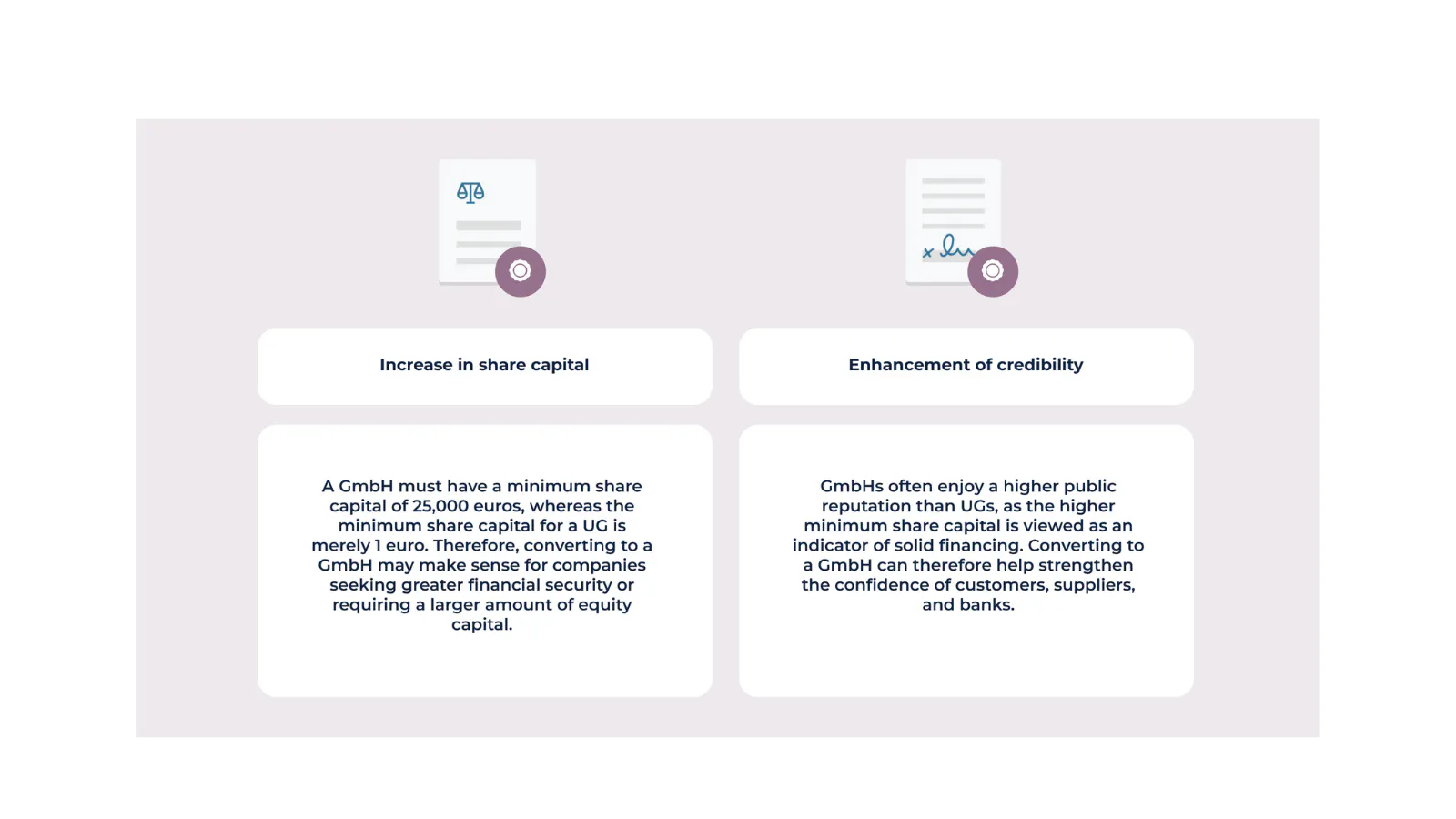
There is no legal obligation to convert a UG into a GmbH (Gesellschaft mit beschränkter Haftung). A UG can therefore, in principle, continue to exist permanently as a UG. However, there are several reasons why entrepreneurs may decide to convert their UG into a GmbH.
Holding Structure: Parent Company & Real Estate UGs – How It Works
For larger real estate portfolios, a holding structure can also be of interest. In this arrangement, a parent company holds shares in one or more real estate companies, allowing different real estate portfolios or business areas to be legally separated from one another.
Whether such a structure makes sense from a tax and organizational perspective depends heavily on the portfolio, financing, and long-term strategy. We explain in detail how to structure a holding company with a UG or GmbH in the article “Setting Up a Holding Company: How the Corporate Structure Works with a UG or GmbH”.
Conclusion: Is Setting Up a Real Estate UG Worth It for You?
Whether establishing a real estate UG is worthwhile for you depends on various factors. A UG can be attractive to entrepreneurs who want to build and manage an extensive real estate portfolio over the long term. Through the UG's corporate structure, managing directors and shareholders can limit their liability risks and potentially benefit from tax advantages.
However, it is important to bear in mind that establishing and operating a UG involves various costs and obligations. These include notary fees, Commercial Register registration fees, and the cost of formation documents. Regular operating expenses such as personnel, rent, insurance, taxes, and loans must also be considered.
If you have more capital available or prefer a GmbH structure from the outset, it is worth comparing the two legal forms. We explain the specific features of a real estate GmbH in our article “Setting Up a Real Estate GmbH: How to Make Proper Use of Tax Advantages and Limited Liability”.
Before deciding to establish a real estate UG, you should carefully consider whether this corporate form is suitable for your purposes and whether you have the necessary resources and financial means to operate the UG successfully. It may be advisable to consult a tax advisor or lawyer who can help you make this decision and explain the advantages and disadvantages of a UG compared with other corporate forms.
Have you determined that a real estate UG fits your plans? Then you can start setting up your UG digitally with beglaubigt.de and prepare the next steps, from the formation documents through to Commercial Register registration.
FAQ on Real Estate UGs
What Is a Real Estate UG?
A real estate UG is not a separate legal form but an Unternehmergesellschaft (haftungsbeschränkt) whose business purpose is focused on real estate. It can, for example, acquire, hold, rent out, and manage its own real estate.
Can a UG Buy Real Estate?
Yes. As a corporation with legal capacity, a UG can generally acquire real estate itself and become the legal owner of property. The planned acquisition and management of real estate should be covered by the company's stated business purpose.
How Much Share Capital Does a Real Estate UG Need?
The capital requirements for a UG are governed by Section 5a GmbHG. The share capital must be paid in full before the company is registered in the Commercial Register; contributions in kind are not permitted upon formation. Particularly for a capital-intensive business model such as real estate, however, the company's actual capitalization should not be based solely on the statutory minimum.
Does a Real Estate UG Pay Trade Tax?
As a corporation, a UG is generally subject to trade tax. However, if the company exclusively manages and uses its own real estate, the extended trade tax reduction under Section 9 No. 1 Sentence 2 et seq. GewStG may apply, subject to the statutory requirements. Certain additional activities can already affect eligibility for this benefit.
Does a Real Estate UG Have to Be Converted into a GmbH Later?
No. A UG can generally remain a UG permanently. However, under Section 5a GmbHG, it must allocate part of its annual net profit to a statutory reserve. A subsequent capital increase to GmbH level is possible but is not automatically required.
Real Estate UG or Real Estate GmbH – Which Is Better?
This depends in particular on capitalization, financing, external perception, real estate strategy, and long-term business planning. A UG allows founders to get started with lower share capital, while a GmbH is established from the outset with share capital of €25,000.
Ready for the next step? Set up your real estate UG with beglaubigt.de and prepare the formation process digitally.
Sources
- Section 5a GmbHG – Unternehmergesellschaft (haftungsbeschränkt), full payment of capital, contributions in kind, and statutory reserves
https://www.gesetze-im-internet.de/gmbhg/__5a.html - GmbHG – German Limited Liability Companies Act
https://www.gesetze-im-internet.de/gmbhg/ - Section 9 GewStG – Extended trade tax reduction for the management and use of own real estate
https://www.gesetze-im-internet.de/gewstg/__9.html - Section 23 KStG – Corporate income tax rate
https://www.gesetze-im-internet.de/kstg_1977/__23.html - Körperschaftsteuergesetz (KStG) – German Corporate Income Tax Act
https://www.gesetze-im-internet.de/kstg_1977/ - Gewerbesteuergesetz (GewStG) – German Trade Tax Act
https://www.gesetze-im-internet.de/gewstg/ - Section 19 GmbHG – Payment of Contributions
https://www.gesetze-im-internet.de/gmbhg/__19.html - Section 7 GmbHG – Registration of the Company and Payment of Contributions
https://www.gesetze-im-internet.de/gmbhg/


