



The Most Important Points in 30 Seconds
- How much needs to be paid in? For a standard GmbH in Germany, the minimum share capital is €25,000. For registration in the Commercial Register, in the case of a cash formation, at least 25% of each share and at least €12,500 in total must generally have been paid in.
- When is the capital paid in? In practice, the payment is made after the company has been notarized and before the GmbH is registered in the German Commercial Register. A business bank account for the GmbH in formation is usually opened first.
- How is the payment proven? As part of the Commercial Register application, the managing director confirms that the required contributions have been made and are definitively at their free disposal. If there are doubts, the registry court may request additional evidence.
- Do you have to pay in €25,000 immediately? Not necessarily in the case of a cash formation. In principle, €12,500 may be sufficient for registration, provided that the statutory minimum contributions for each individual share are also met. Any outstanding contribution obligations continue to exist afterward.
- Contributions in kind work differently: If vehicles, machinery, real estate, or other assets are contributed instead of cash, additional requirements apply to the articles of association, formation report, valuation, and full contribution before registration.
- Continue setting up your GmbH in Germany: Once the articles of association and capital contribution have been prepared, you can start your GmbH formation digitally with beglaubigt.de and prepare the next steps through to Commercial Register registration.
When and How Must GmbH Share Capital Be Paid In?
Paying in the share capital is one of the key steps between the notarized formation of a GmbH and its registration in the German Commercial Register. Following notarization, in the case of a cash formation, a business bank account is typically opened for the GmbH in formation, into which the shareholders pay their agreed contributions.
The statutory minimum share capital for a GmbH in Germany is €25,000. However, this does not mean that the entire €25,000 must always have been paid in before registration in the Commercial Register. The requirements of Section 7 (2) GmbHG are decisive.
Proper documentation of the capital contribution is particularly important. As part of the Commercial Register application, the management must confirm that the required contributions have been made and are definitively at its free disposal. Errors concerning the amount, payment method, or provision of capital can therefore result in questions and delays during the registration process.
Below, you will learn how the payment process works, which evidence may be relevant, when a partial payment is possible, and which special requirements apply to contributions in kind.
Have you already prepared your articles of association? Then you can start your GmbH formation digitally with beglaubigt.de and prepare the next steps—from notarization and payment of the share capital through to registration in the German Commercial Register.
1. Legal Basis & Formal Requirements
What Does “Paying in GmbH Share Capital: What You Need to Know” Mean Legally?
Under Section 5 (1) GmbHG, the share capital (Stammkapital) forms the financial basis of a GmbH and plays an important role in limiting liability. In principle, shareholders are not liable with their personal assets but only up to the amount of their contribution obligation.
Before registration in the Commercial Register, Section 7 (2) GmbHG requires at least half of the minimum share capital, i.e. €12,500, to have been actually paid in. The required amount must be definitively available to the company.
The contribution requirement is not merely a formality. It serves as a central mechanism for protecting creditors, as it ensures that the GmbH has a minimum level of capital when it is established. If this requirement is not met, the registry court may refuse registration. Violations may also result in civil liability risks.
For registration, the managing director must provide an assurance that the contributions have been made in accordance with Section 8 (2) GmbHG. This declaration must be truthful—otherwise, criminal consequences may arise under Section 82 GmbHG.
German case law (Federal Court of Justice, judgment of July 9, 2013 – II ZR 9/12) makes clear that the actual availability of the contribution is decisive. Mere accounting entries or intermediary trust arrangements are not sufficient.
What Happens If the Capital Has Not Been Fully Paid In at the Time of Formation?
Under Section 7 (2) GmbHG, payment of at least half of the minimum share capital is a requirement for registration of the GmbH in the Commercial Register. The registry court examines whether this requirement has been met based on the corresponding assurance provided by the managing director.
If evidence of payment is missing or the assurance is insufficient, registration may be refused. In that case, the company does not yet exist as a fully registered legal entity and remains a company in formation.
Typical obstacles to registration include:
- no payment into the company account
- failure to meet the minimum amount of €12,500
- an unclear or formally defective assurance under Section 8 (2) GmbHG
If a formal deficiency is identified, the registry court may grant an additional deadline to make the payment or correct the documents. If this is not done, the registration procedure may be discontinued or finally rejected.
Where contributions have already been made but have not been properly documented, repayment obligations toward shareholders may also arise if registration ultimately fails. In practice, this means: no registration, no fully established GmbH—but potentially costs and liability risks nonetheless.
It is not possible to waive the contribution requirement or proceed with registration “at your own risk.” German case law emphasizes the need for clear and complete documentation of the capital contribution at the time of registration.
2. Documentation & Evidence Requirements
How Is the Payment Documented?
In practice, the payment of the GmbH share capital is documented in several stages. A bank confirmation or bank statement can show the amount paid, the date of payment, and the GmbH account receiving the funds.
Such confirmation is not automatically required by law in every case. However, a German registry court may request additional evidence if there are uncertainties regarding the proper contribution of the share capital. The documentation helps demonstrate that the capital was actually available to the company at the time of registration.
At the same time, the articles of association allocate the respective contribution amounts to the individual shareholders. This allocation is necessary so that internal liability relationships and potential repayment claims can later be clearly determined.
Example wording in the agreement:
“Mr. A assumes a share with a nominal value of €12,500, the contribution for which he pays in cash into the company's account.”
As part of the Commercial Register application, the managing directors confirm under Section 8 (2) GmbHG that the contributions have actually been made and are freely available to the company. False statements may result in criminal penalties under Section 82 GmbHG.
Many founders use specialized platforms such as beglaubigt.de to organize the necessary formation documents and prepare them systematically for the registration process.
What Role Do the Notary and Commercial Register Play?
The articles of association of a GmbH in Germany must be notarized. Once notarization and the required capital contribution have been completed, the company is electronically submitted for registration in the Commercial Register through the notary.
The managing directors provide, among other things, the legally required assurance regarding payment of the contributions. If there are specific doubts as to whether the share capital has been properly provided or is actually available to the company, the registry court can request additional evidence.
Company formations and certain Commercial Register applications in Germany can now also be completed through online notarial procedures, provided the statutory requirements are met.
Is Special Wording Required for Proof of Payment?
When documenting the payment, it is advisable to use a clear payment reference that identifies both the type of contribution and the relevant shareholder.
For example:
“GmbH share capital contribution – Max Mustermann”
This makes it easier to identify both the type of payment and the shareholder making the contribution.
Unclear or very general payment references—such as “GmbH account” or “capital”—can make verification more difficult. Precise wording improves traceability and can help minimize questions during the registration process.
The amount shown on the bank statement should correspond exactly to the contribution specified in the articles of association. It should also be possible to link the payment to the relevant shareholder, particularly where several shareholders are making contributions.
Evidence of the payments should be carefully retained before registration, even if it does not automatically need to be submitted in every case. These documents may become important if the German Commercial Register requests additional information or if evidence is required later.
3. Common Mistakes & Preventive Strategies
How Can Mistakes When Paying in the Capital Be Avoided?
In practice, mistakes in providing the share capital can be avoided through structured preparation of the payments. A simple checklist can help prevent common omissions.
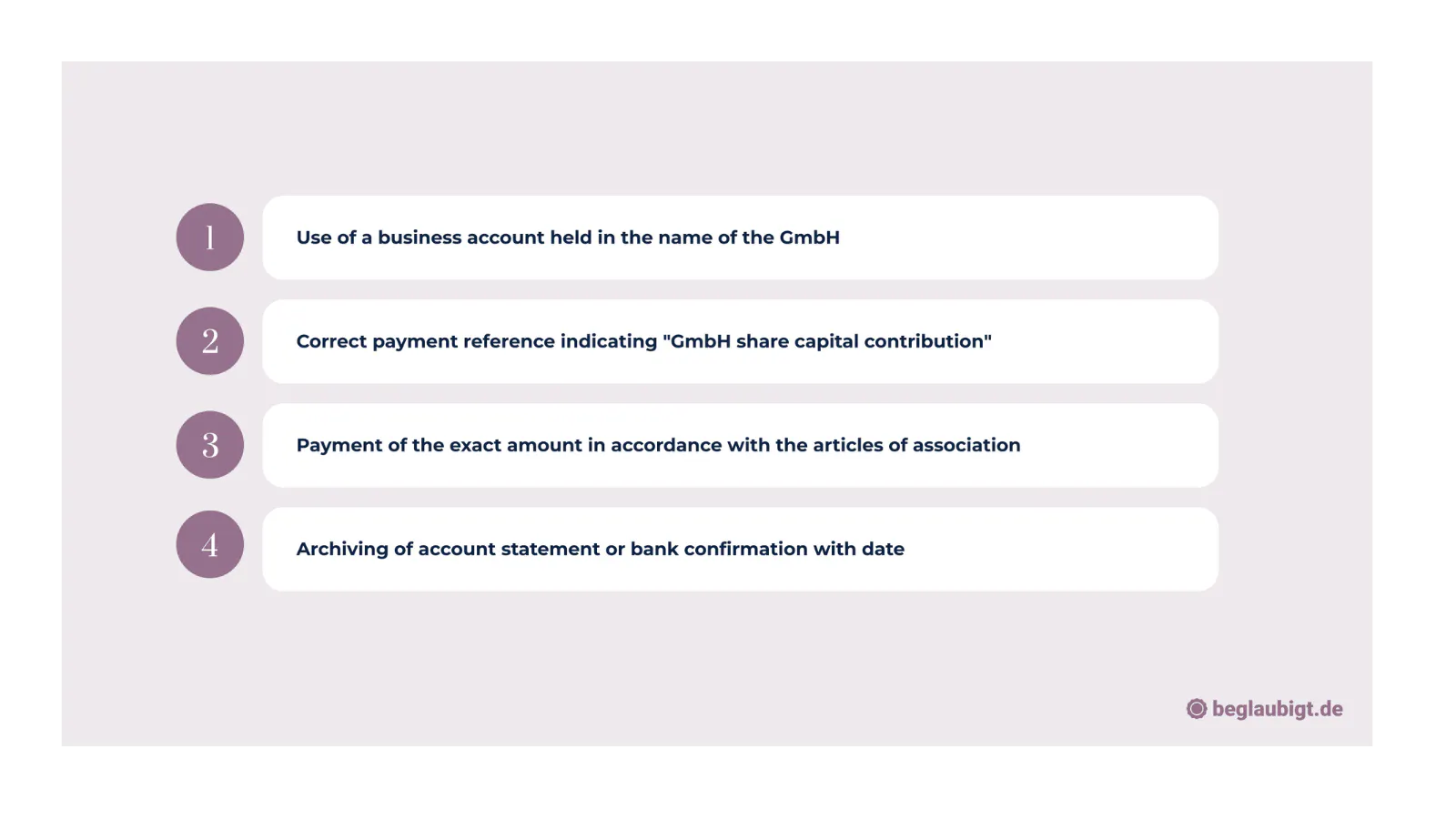
It can also be useful to have the planned payment process reviewed in advance by the notary or a specialized legal-tech provider familiar with company formations in Germany. This can help identify issues relating to the payment method, documentation, and formal requirements before the registration is submitted.
In individual cases, a small test transfer may help identify problems with bank details, payment references, or account activation before the actual capital contribution is made.
Founders who want to organize the formation process efficiently can find practical information on timing and formal requirements in the article When Should You Set Up a GmbH?.
What Are the Consequences of an Incorrect Capital Contribution?
If the required share capital has not been properly provided, registration in the Commercial Register may initially be delayed. Where doubts exist, the registry court may request additional documents or reject the application if the statutory requirements cannot be demonstrated.
Incorrect statements in the managing director's assurance are particularly serious. Anyone who provides false information to the registry court concerning the capital contribution may face civil and criminal consequences.
In addition, contribution obligations that have not been properly fulfilled generally remain outstanding. Shareholders should therefore not assume that registration in the Commercial Register automatically remedies every error relating to the capital contribution.
4. Further Capital Scenarios
Can GmbH Share Capital Be Paid in Installments?
In the case of a cash formation, the entire €25,000 does not necessarily have to be paid in before the Commercial Register application. Under Section 7 (2) GmbHG, at least one quarter of the nominal value of each share must be paid in; in total, the paid-in cash contributions together with fully completed contributions in kind must amount to at least €12,500.
Any outstanding portion of the agreed contributions continues to exist as a contribution obligation. It may subsequently be called in by the company.
Founders who deliberately want to start a company in Germany with significantly less capital can also consider whether a UG (haftungsbeschränkt) is more suitable for their business model. Our article “Setting Up a Mini-GmbH – How It Works” explains how the so-called Mini-GmbH works.
How Do Contributions in Kind Work as Share Capital?
Anyone who wants to contribute assets rather than cash toward the share capital must make a contribution in kind (Sacheinlage) under Section 5 (2) GmbHG. A formation report for contributions in kind is required, setting out the asset, its value, and the basis for its valuation in detail.
Permitted contributions in kind may include patents, machinery, vehicles, or real estate. The value of the contributed assets must correspond to the nominal value of the share specified in the articles of association. The relevant value is the asset's value at the time it is contributed.
The requirements regarding transparency and value are strict. The registry court examines whether the economic value corresponds to the nominal value of the share under Section 9 GmbHG. Overvaluation can result in additional contribution obligations or even personal liability under Section 9a GmbHG.
Contributions in kind are particularly relevant in the context of real estate companies. Our article Setting Up a Real Estate GmbH – How to Properly Use Tax Advantages and Limited Liability explains this structure in more detail.
Can the Share Capital Be Changed Later?
Yes. After formation, the share capital of a GmbH can generally be increased or, subject to the statutory requirements, reduced. However, these are no longer part of the original payment of the company's formation capital but separate corporate-law capital measures.
Capital increases and reductions generally require corresponding shareholder resolutions, notarial involvement, and registration in the German Commercial Register. Sections 55 et seq. GmbHG apply to their implementation.
If changes to the provisions of the articles of association are also required, the existing articles should be reviewed. Our article “GmbH Articles of Association: Content, Form, and Common Drafting Mistakes” explains what they should contain and which mistakes commonly occur.
5. Tax Consequences & Commercial Register Process
Does Paying in GmbH Share Capital Have Tax Consequences?
Paying a cash contribution toward the share capital of a GmbH generally does not constitute ordinary taxable operating income for the company. On the balance sheet, the share capital is reported as subscribed capital within equity.
The situation can become more complex with contributions in kind. If existing businesses, shareholdings, or assets containing hidden reserves are contributed, additional tax issues may arise. Such contributions should therefore be individually reviewed from a tax perspective before implementation.
The tax treatment of the GmbH's subsequent profits or distributions must be distinguished from the original payment of its share capital.
What Commercial Register Processes Follow the Capital Contribution?
After the share capital has been paid in, the GmbH is registered by the competent German local court once the statutory requirements for registration have been met. The formation documents required under Section 8 GmbHG include the managing director's assurance regarding the availability of the capital under Section 8 (2) GmbHG.
The registration is subsequently published in the electronic Commercial Register. From this point onward, the company formally exists as a GmbH and has legal capacity. It can participate in legal transactions as a legal entity.
Following registration, additional statutory obligations arise, including requirements concerning the shareholder list and the preparation of annual financial statements under German law.
The company's formation also leads to further administrative and tax-related steps with the relevant German authorities.
Good coordination between the notary and the parties involved in the registration can help ensure that the Commercial Register process runs smoothly. Digital solutions such as beglaubigt.de can help founders prepare and coordinate the required registration documents.
Continue Your GmbH Formation in Germany Digitally After Paying in the Capital
Once the articles of association and capital contribution have been prepared, the Commercial Register application and other formal formation steps follow. With beglaubigt.de, you can coordinate the formation process digitally and prepare the required documents for the next steps.
Start your GmbH formation in Germany digitally
FAQ on Paying in GmbH Share Capital
Do I Have to Pay €25,000 Immediately When Setting Up a GmbH?
No. In the case of a cash formation, the entire €25,000 does not generally have to be paid in before the Commercial Register application. Under Section 7 (2) GmbHG, however, at least 25% of the nominal value of each share and at least €12,500 in total must have been contributed. Any outstanding contribution obligations remain in place.
When Is the Share Capital Paid In?
In the case of a cash formation, the contribution is typically made after the articles of association have been notarized. A business account for the GmbH in formation is then opened and the agreed contribution is paid in before the Commercial Register registration process is completed.
Do I Need a Bank Statement for the Commercial Register?
A bank statement or bank confirmation does not automatically have to be submitted with every GmbH registration in Germany. However, if there are doubts about whether the capital has been properly provided, the registry court may request additional evidence. Payment records should therefore be retained carefully.
Can I Pay the Share Capital Into My Personal Bank Account?
The capital must be provided in such a way that the contribution is actually and definitively available to the company. For a cash formation, an account for the GmbH in formation is therefore typically opened after notarization, and the contributions are paid into that account.
Can I Contribute a Car or Property Instead of Money?
Yes. Contributions in kind are generally permitted when establishing a GmbH. However, they must be specified in the articles of association, fully contributed, and have sufficient value. A formation report for contributions in kind is also required.
What Happens to the Remaining €12,500?
If only the €12,500 required for registration has initially been paid in during a cash formation, the shareholders remain obligated to provide the outstanding portion of the contributions they have assumed. The company can call in the outstanding contribution at a later date.


