Germany’s online notarial procedure supports German identity cards with an active eID function, suitable electronic residence permits, German eID cards for EU/EEA citizens and supported foreign electronic identities. An official photograph that can be read electronically is generally also required. A passport alone does not replace the required eID. [1] [4]
You want to attend a notary appointment online, have your ID ready and only discover during registration that you are missing your PIN or need another document. These problems can often be avoided by checking two separate requirements beforehand: electronic proof of identity and an official photograph. Not every document fulfils both functions. The issue date can also matter.
This article covers identification in Germany’s online notarial procedure. Other processes, such as a bank’s identity check, ordering a certified translation or submitting a document copy digitally, do not automatically follow the same rules. The particular notarial act must also be legally permitted by video communication. Having a technically suitable ID does not make every type of certification available online.
Through beglaubigt.de, you can prepare your signature certification request and coordinate the appropriate procedure. An independent notary carries out the notarial identity verification and certification. This guide explains which documents to have ready and what options are available if you do not have a usable eID.
Key takeaways in 30 seconds
- German identity card: Generally suitable for electronic identification if the online ID function is active and you know your personal PIN.
- Check the issue date: German identity cards issued on or after 2 August 2021 generally also allow the photograph to be read electronically. Older cards usually require a suitable passport as an additional document for the photograph.
- Electronic residence permit: A suitable electronic residence permit, or eAT, with an activated online ID function and PIN can also be used. Test the specific card in advance.
- German eID card for EU/EEA citizens: This provides electronic proof of identity but contains no photograph. A suitable additional photo document is required.
- Foreign EU/EEA eID: The identification means must be recognised at the “high” assurance level and technically supported. Not every national identity card qualifies.
- Passport alone: A suitable passport can provide the photograph, but does not replace a missing eID.
- Without a usable eID: Resolve PIN or activation issues, obtain an accepted identification means or discuss an in-person appointment.
- beglaubigt.de: When preparing your certification request, provide details of the document and your available ID early so that a suitable procedure can be coordinated.
1. What kind of online certification does this article cover?
Why do the identification requirements depend on the procedure?
Online notarial certification does not simply involve confirming a handwritten signature during an ordinary video call. § 40a BeurkG governs the certification of a qualified electronic signature. Certification by video communication is only permitted where legislation allows it. For Commercial Register applications, for example, § 12 HGB expressly provides for this option. Before checking your ID, it is therefore necessary to establish what you want to sign or register and which legal form is required. [2] [3]
Online notarisation of a deed and online signature certification are also different notarial acts. Similar identification requirements apply within their respective legal frameworks, but the notary’s work differs. If you first need to establish which form is appropriate, our article on online notarisation and online certification can help. For register-related matters, see our guide to online certification of Commercial Register applications.
2. Check electronic identity and the photograph separately
How does the two-stage identification process work?
The standard online notarial procedure combines two forms of verification. First, your electronic identity is checked using an accepted electronic identification means. In addition, an official photograph is generally read electronically from a suitable document and compared with you during the appointment. A photograph of your ID or a portrait you upload yourself does not replace this reading process. The legal basis is § 16c BeurkG, which applies correspondingly to online certification. [1] [2]
Both forms of verification can come from the same document, but they do not have to. A newer German identity card can generally meet both requirements. An older identity card may provide a working eID while a passport is needed for the photograph. A German eID card for EU/EEA citizens, meanwhile, contains no photograph at all. Do not just ask, “Is my document valid?” Also ask, “Which function does it fulfil in this procedure?”
3. Which ID documents work?
Is a German identity card sufficient?
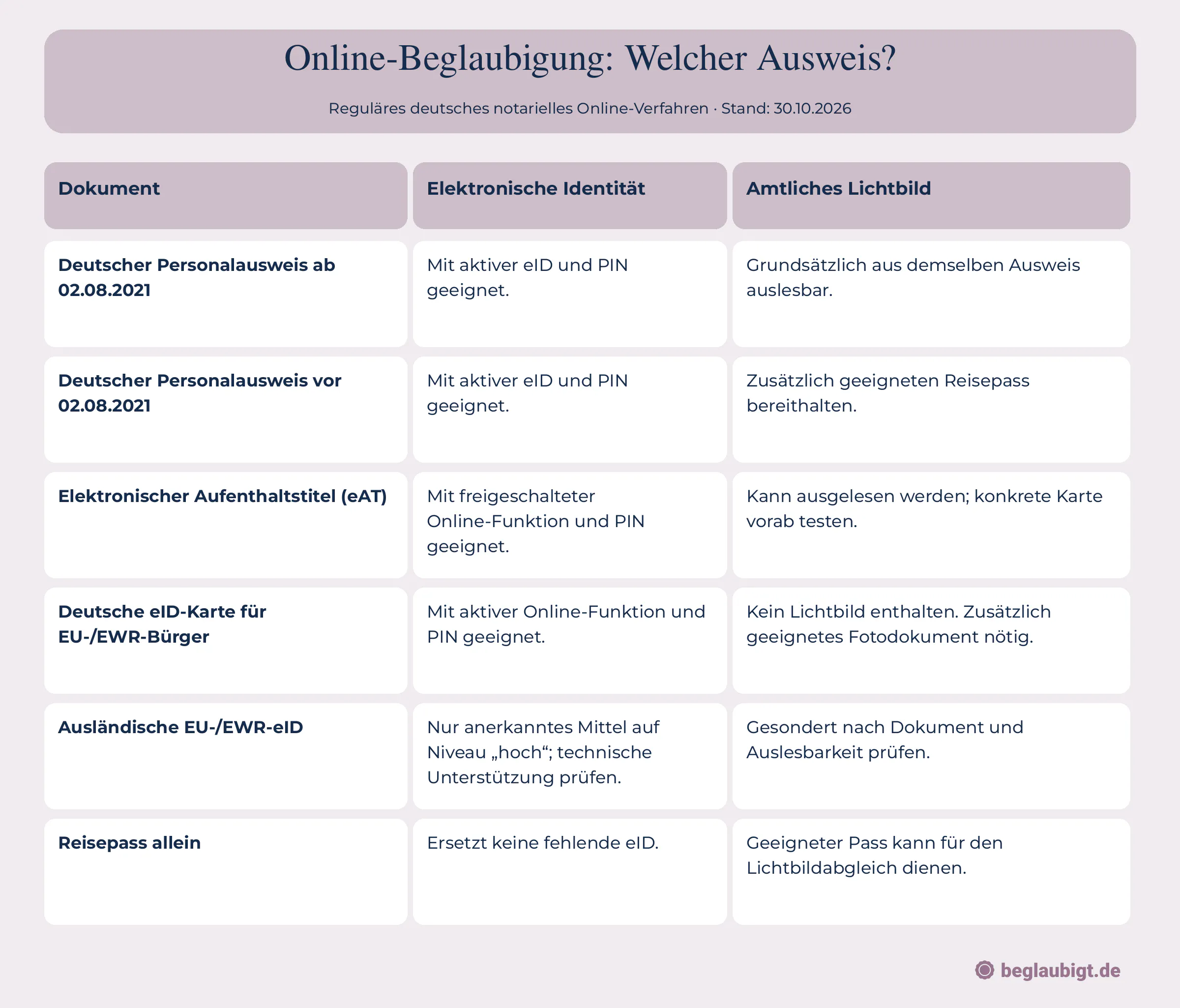
A valid German identity card can be used for electronic identification if its online ID function is usable and you know your personal PIN. The issue date matters for the photograph check: according to the German Federal Chamber of Notaries, photographs can be read from German identity cards issued on or after 2 August 2021. The relevant date is when the card was issued, not when it expires. [4] [5]
An older valid identity card is therefore not automatically unsuitable. It may provide the eID, while a suitable passport is generally needed as an additional document for the photograph. For example, suppose your identity card was issued in September 2020 and its online function is active. Rather than applying for a new card solely because of its age, first check whether your existing passport can fulfil the second identification stage. [9]
Can you use an electronic residence permit?
A suitable electronic residence permit, known as an eAT, can be used for electronic identification. Its online ID function must be activated and usable, and you need the PIN. What matters is the specific electronic card: a paper document confirming residence or a right of residence does not, by itself, qualify as an equivalent eID. German citizenship is therefore not a general requirement for taking part in the online notarial procedure. [4]
According to the German Federal Chamber of Notaries’ specific FAQ on photographs, an electronic residence permit can also be used to read the photograph. Nevertheless, test your particular card before the appointment and clarify whether you should also have a suitable passport available. The 2 August 2021 cut-off for German identity cards should not automatically be applied to all residence permits. A non-EU/EEA national with a suitable German eAT may therefore have different options from someone who only holds a foreign passport. [6]
What is the German eID card for EU and EEA citizens?
The German eID card, sometimes called the Unionsbürgerkarte, is intended for nationals of other EU or EEA countries. It is available from the age of 16 and provides electronic proof of identity. However, it is neither an ordinary identity card nor a travel document. In particular, it contains no photograph.
For the online notarial procedure, you therefore generally need an additional suitable document for the photograph check, usually an appropriate passport. [7]
This card is distinct from an electronic identity issued by another EU/EEA country. It is also not an option available to every foreign national: someone who holds only the nationality of a non-EU/EEA country does not become eligible simply because they plan to attend a German notary appointment. EU/EEA nationals can also check whether they can apply through a competent German diplomatic mission abroad. Availability and processing times need to be established well in advance. [8]
Which foreign EU and EEA eIDs are accepted?
A foreign national identity card is not automatically suitable for the online notarial procedure. Under § 16c BeurkG, the electronic identification means must meet the recognition requirements specified there and be notified at the “high” assurance level. The particular identification means must also be technically supported by the procedure. The German Federal Chamber of Notaries publishes current information and an overview of suitable documents. Country lists and technical availability may change; your particular identification means remains decisive. [1] [8]
Check the two stages separately here, too. Having a supported foreign eID does not establish which document you can use for the photograph. Conversely, a foreign passport may provide a suitable photograph without qualifying as an accepted eID. Tell the notary the issuing country, document type and issue date, rather than just your nationality. For mobile identification means, the eID steps may differ from reading a German card.
4. Passports, driving licences and other identification situations
Warum reicht der Reisepass allein nicht aus?
A suitable passport can provide the official photograph that must be read electronically. It does not, however, replace the required electronic proof of identity. The fact that your passport contains a chip and is valid for travel does not establish that you can use it to complete the entire notarial identification process. This distinction is particularly important for international participants who travel to Germany with only their passport or want to attend the appointment from abroad. [1] [6]
For example, someone may hold a valid foreign passport but have neither a suitable eAT nor a supported EU/EEA eID. A newer passport alone does not resolve the missing first identification stage. First, establish whether an accepted eID is available or can be obtained. Otherwise, an in-person appointment may be appropriate. An ordinary video call in which you hold up your passport is not an equivalent substitute for Germany’s online notarial procedure.
Can you use a driving licence, an ID copy or a previous video identification check?
An ID copy, a photograph you take yourself or a successfully completed identity check with another service does not replace the statutory requirements of the notarial procedure. A driving licence is not a general alternative to the required eID either. A temporary German identity card contains no chip and therefore has no online ID function. It does not resolve a missing eID.
Whether a particular foreign document is supported for one part of the procedure must be checked against the current document information. Suitability for one stage does not establish suitability for both. [18]
Having already been identified by a bank or another online service therefore does not automatically simplify the notarial check. The notary must establish your identity through the prescribed procedure. If you are unsure which form of certification you need, start with our overview of the differences between certification, notarisation, apostilles and legalisation.
5. What happens if you do not have a usable eID?
What can you do if you have lost your PIN or the online function is deactivated?
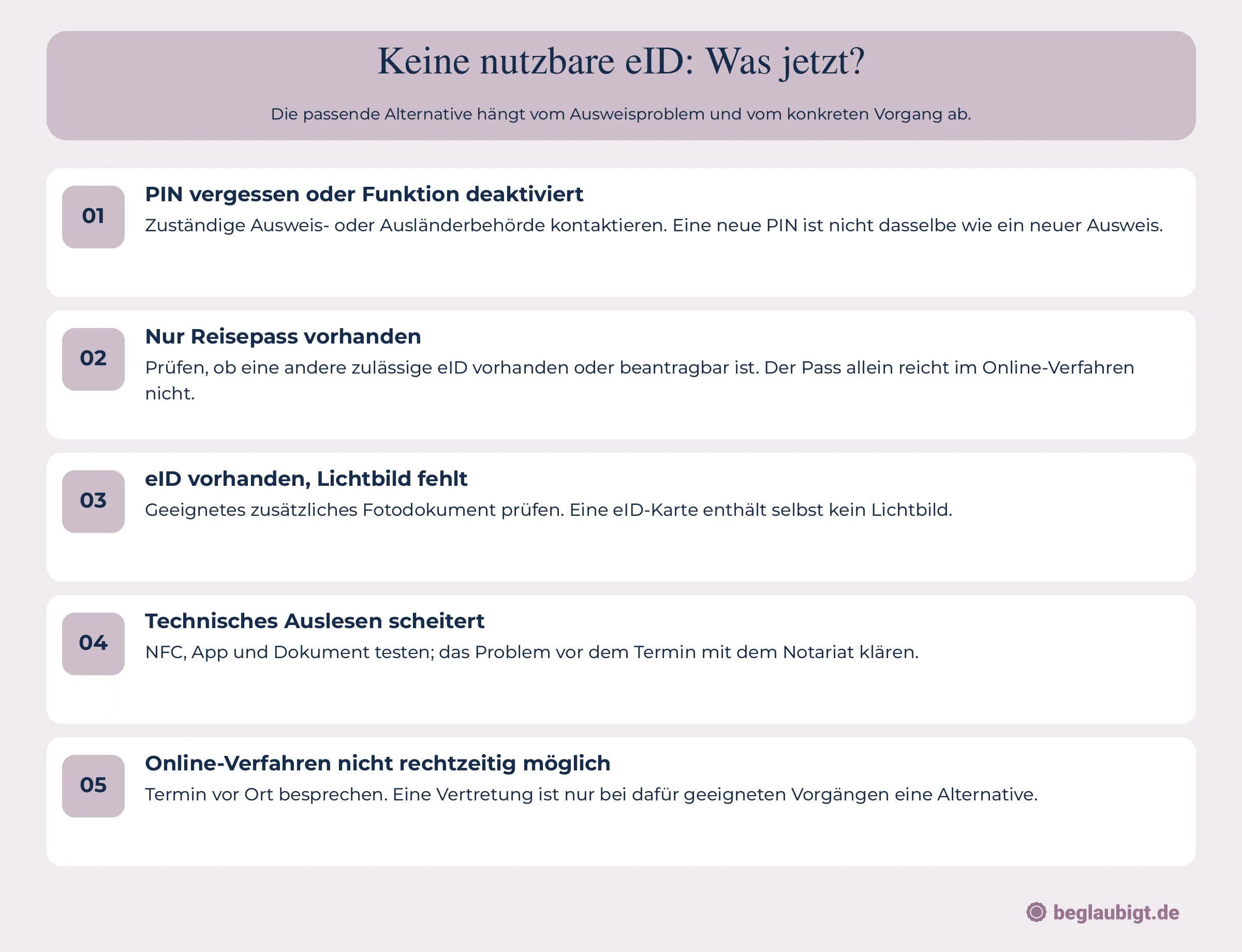
Not knowing your PIN is different from not having a suitable identity document. If your document is supported in principle, first check its activation, PIN and, where relevant, whether the online function has been blocked. The five-digit initial or transport PIN is changed to a personal six-digit PIN before first use. If you know your existing PIN, you can change it using the designated software. If you have forgotten it, a different recovery process is required. [10]
The Federal Portal describes the option of having a new PIN set free of charge by the competent identity card authority or foreigners authority. Responsibility and appointment availability depend on the document and authority concerned. Check any additional recovery options currently available directly with the responsible official bodies. A new PIN does not mean a new identity card or an immediately available notary appointment. Do not share your PIN with a formation service or send it by email. Enter it only within the designated identification process. [11]
What alternatives are available if you have no accepted eID?
If you do not have a suitable eID, first establish whether you can apply for one and whether obtaining it makes sense within your timeframe. German citizens may be able to obtain a German identity card; eligible EU/EEA nationals may apply for the German eID card. An eAT, meanwhile, depends on the relevant immigration requirements. It is not issued solely to allow someone to attend a notary appointment.
Do not assume that everyone can obtain the same card at short notice.
If electronic identification cannot be arranged in time, an in-person notary appointment remains an important alternative. Representation may also be considered for suitable transactions. However, it is not a universal substitute for every declaration that must be made personally. For a GmbH formation, § 2(2) GmbHG requires a power of attorney executed or certified by a notary where an authorised representative signs.
Foreign documents may raise additional questions about form, translation and authentication. Agree these points with the responsible notary in advance. Also explain your available identification documents when preparing your certification request through beglaubigt.de, so they can be taken into account when planning the procedure.
What happens if only one participant has no eID?
Where several people are involved, identification must work for every person participating online. One co-founder’s suitable eID does not replace another participant’s missing eID. Whether some people can attend in person while others join by video depends on the transaction and the notary’s arrangements. For notarisation of deeds, § 16e BeurkG governs this mixed procedure. Discuss any such arrangement before booking. [17]
When preparing a joint appointment, therefore, collect details of every participant’s documents. This helps establish early whether an additional passport is sufficient, a PIN needs resetting or another procedure would be more appropriate. For company formations, our article on setting up a UG online with a notary explains how identification fits into the overall process.
6. Technology and preparation before the appointment
Which devices and applications do you need?
For the standard procedure, the German Federal Chamber of Notaries lists an NFC-enabled smartphone with the Notar app and a computer or suitable tablet with a camera, microphone and speakers, plus a supported browser. You also need a stable internet connection and the required documents. The procedure will guide you through the steps for your electronic identification means. With foreign mobile eIDs, the first identification stage may work differently from reading a German identity card. [9]
Test whether your documents can be read well before the appointment. A successful eID test does not automatically mean that the photograph can also be read from the intended document. Check both functions where tests are available. If a chip is not detected, factors may include the phone’s position, NFC support or its case. Resolve repeated technical problems with support or the notary before the appointment, rather than assuming the check can be waived. [5]
What information should you gather beforehand?
1. Identify the transaction and document. What needs to be certified or notarised, and which organisation requires it? This determines whether Germany’s online notarial procedure is available at all.
2. Record the identification means. Note the document type, issuing country, issue date and validity. Establish which identification means will provide the eID and which document will provide the photograph.
3. Check the PIN and activation. Confirm that the online function is usable and that you know the required PIN. A copy of the ID alone is insufficient.
4. Test the technology. Check your smartphone, NFC, app, camera and internet connection. Where available, use the tests provided for the eID and photograph.
5. Resolve outstanding questions before booking. If several people are involved, carry out these checks for everyone. Report problems early so that an alternative procedure can be arranged.
7. Costs and your next step
What costs apply to the eID, PIN and online procedure?
For the standard issuance of a German eID card for EU/EEA nationals, § 2 PAuswGebV provides for a fee of €37. Additional fees may apply to particular services. This is separate from having a PIN reset free of charge by the competent authority, which does not automatically involve issuing a new card. Processing times and appointment availability also need to be considered separately. [12] [11]
The cost of the notarial act depends on the specific work and statutory fees. For use of the video communication system, the German Federal Chamber of Notaries lists an additional €8 per certification procedure or €25 per notarisation procedure, both excluding VAT. These amounts are not the complete final prices for certification or notarisation. Private service charges must also be considered separately. [13]
Further guides to online certification
- Online certification of Commercial Register applications: Process, notary and costs
- Online notarisation or online certification: Which procedure is appropriate?
- Certification or notarisation: What is the difference?
- Online notarial certification: Process and requirements
- Certification, notarisation, apostille or legalisation: An overview of the procedures
Next step with beglaubigt.de: Prepare your document and identification details together
Would you like to know which procedure is available for your document? Through beglaubigt.de, you can prepare your certification request and provide details of your available ID at an early stage. Specify the document type and whether you have a usable eID and a suitable photo document. An independent notary carries out the notarial review and decides which procedure is appropriate.
Costs: These depend on the document, required procedure and agreed services. Before placing your order, ask for the specific scope and any additional statutory fees to be explained. Prepare your signature certification request and coordinate the appropriate procedure
FAQ about ID documents for online notarial certification
Is my identity card sufficient without a passport?
A valid German identity card issued on or after 2 August 2021 can generally provide both the eID and photograph. The online function, PIN and ability to read the document electronically must all work. [9]
Is an older identity card unusable?
No. It may still be suitable for electronic identification. For German identity cards issued before 2 August 2021, a suitable passport is generally also needed for the photograph. [5]
Can I use an electronic residence permit?
A suitable eAT with a usable online function and PIN can provide the eID. It may also be a suitable document for the photograph. Check the particular card beforehand and clarify whether additional documents are needed. [4] [6]
Is an EU eID the same as the German eID card for EU citizens?
No. The German eID card for eligible EU/EEA citizens is a specific document. Recognised foreign electronic identification means may also be supported. The requirements and technical steps must be checked for the particular identification means.
Can I participate using only a foreign passport?
A suitable passport can provide the photograph, but does not replace the required eID. What matters is whether you also have an accepted electronic identification means. A chip in the passport alone is insufficient.
Can I activate the online ID function without obtaining a new card?
If your existing document is suitable in principle, resolving activation and PIN issues may be sufficient. Check with the competent authority. Forgetting your PIN does not automatically mean you need a new identity card.
Do I have to be German or live in Germany?
German citizenship is not a general requirement. Suitable residence permits and supported EU/EEA identification means may also qualify. Whether your particular transaction can be completed online from abroad must be agreed with the responsible notary.
Is holding my ID up to the camera sufficient?
No. Germany’s online notarial procedure requires the prescribed electronic identification and, as a rule, the electronic photograph check. An ordinary video identification process or an ID copy does not replace these steps.
Can the notary waive the photograph requirement if they know me?
§ 16c BeurkG provides an exception to the electronic transmission of the photograph if the participant is known to the notary. This does not create a general exemption from the required eID. The notary determines whether the exception applies. [1] [15]
What happens if identification fails during the appointment?
The statutory requirements cannot be replaced with an improvised video procedure. The notary must establish whether the problem can be resolved or whether another appointment or procedure is needed. Checking in advance reduces this risk.
Sources
[1] § 16c BeurkG — Identification of participants by video communication
[2] § 40a BeurkG — Certification of a qualified electronic signature
[3] § 12 HGB — Applications for registration and submissions
[4] German Federal Chamber of Notaries — Suitable German identity documents for eID
[5] German Federal Chamber of Notaries — Reading the photograph from a German identity card
[6] German Federal Chamber of Notaries — Identity documents required for the photograph
[7] Federal Portal — Applying for an eID card: Purpose and eligibility
[8] German Federal Chamber of Notaries — Suitable foreign electronic identification means
[9] German Federal Chamber of Notaries — Technical requirements and identity documents
[10] AusweisApp — Frequently asked questions about PINs and online identification
[11] Federal Portal — Obtaining a new PIN for online ID functions
[12] § 2 PAuswGebV — Fee for the eID card
[13] German Federal Chamber of Notaries — Fees for online notarial procedures
[14] beglaubigt.de — Signature certification
[16] § 2 GmbHG — Form of the articles of association and powers of attorney for company formation
[17] § 16e BeurkG — Mixed in-person and video notarisation
[18] City of Baden-Baden — Temporary identity cards: No online ID function