The articles of association establish how your GmbH is organised and how its shareholders work together. They contain the mandatory provisions on the company’s name, registered office, business purpose, share capital and shares. They can also address important questions about decision-making, share transfers and what happens when a shareholder leaves.
Particularly where several founders are involved, these arrangements deserve careful consideration before the notary appointment. A 50/50 ownership split, for example, does not explain how disagreements will be resolved or what happens if one founder wants to leave. This guide explains the required contents, when a statutory model protocol may be sufficient and which mistakes to avoid when drafting or later amending your GmbH’s articles.
Key takeaways in 30 seconds
- “Articles of association” and “Gesellschaftsvertrag” refer to the GmbH’s governing document. It contains the statutory provisions and can include additional arrangements between the shareholders.
- § 3 GmbHG specifies the minimum contents: the company name, registered office, business purpose, share capital, and the number and nominal amounts of the shares subscribed for by each shareholder.
- Notarisation is mandatory. Where the legal requirements are met, the formation deed can also be notarised through the German online notarial procedure.
- The model protocol is not restricted to sole founders. The simplified procedure under § 2(1a) GmbHG permits a maximum of three shareholders and one managing director.
- Representation and later amendments require particular attention. Where several managing directors are appointed, joint representation is the statutory default. Amendments require a notarised resolution and take legal effect only upon commercial register entry.
- beglaubigt.de: Prepare your GmbH formation digitally and organise the appropriate structure and next steps.
The principal statutory provisions are §§ 2, 3, 35, 53 and 54 GmbHG. [1] [2] [3] [6] [7]
1. Understanding the foundations of GmbH articles of association
What legal requirements apply to GmbH articles of association?
The articles of association provide the legal foundation for the GmbH. They establish its business purpose and capital structure and can define the shareholders’ rights and obligations. Section 3 GmbHG specifies the information that the document must contain. [1]
Their importance extends beyond the formation itself. The articles provide the framework for matters such as shareholder decisions, management arrangements and changes to the company’s capital. If disagreements arise, their wording becomes an important reference point for determining the parties’ rights.
The articles also matter outside the company. They are submitted to the commercial register and can be inspected through the register system. Founders should therefore consider which arrangements belong in the articles and which may require separate documentation.
Notarisation is compulsory. Clear drafting and properly coordinated provisions help prevent uncertainty during registration and throughout the company’s operation. Where foreign-language documents or international shareholders are involved, language and translation requirements should be clarified before the appointment. [2]
How do a model protocol and individually drafted articles differ?
The statutory model protocol under § 2(1a) GmbHG provides a simplified formation document for a company with no more than three shareholders and one managing director. It combines the prescribed articles with the appointment of the managing director and the shareholder list.
It can be suitable for a straightforward formation where the statutory wording meets the founders’ needs. However, it does not allow additional provisions to be inserted freely. The choice should therefore depend on the required arrangements, rather than simply the number of founders.
Individually drafted articles offer more scope to address matters such as voting arrangements, share transfers, additional payment obligations or the departure of a shareholder. They can be particularly useful where several founders have different responsibilities, financial interests or long-term plans.
The main distinction is:
- Model protocol: Prescribed wording for a qualifying simplified formation, with limited scope for individual arrangements.
- Individual articles: Provisions tailored to the company’s requirements, subject to the applicable legal limits.
Section 2(3) GmbHG also provides for separate statutory model documents for video formations. [2]
Our article on the GmbH model protocol and its legal requirements explains the simplified procedure in more detail.
2. Required contents of GmbH articles of association
Which provisions are mandatory?
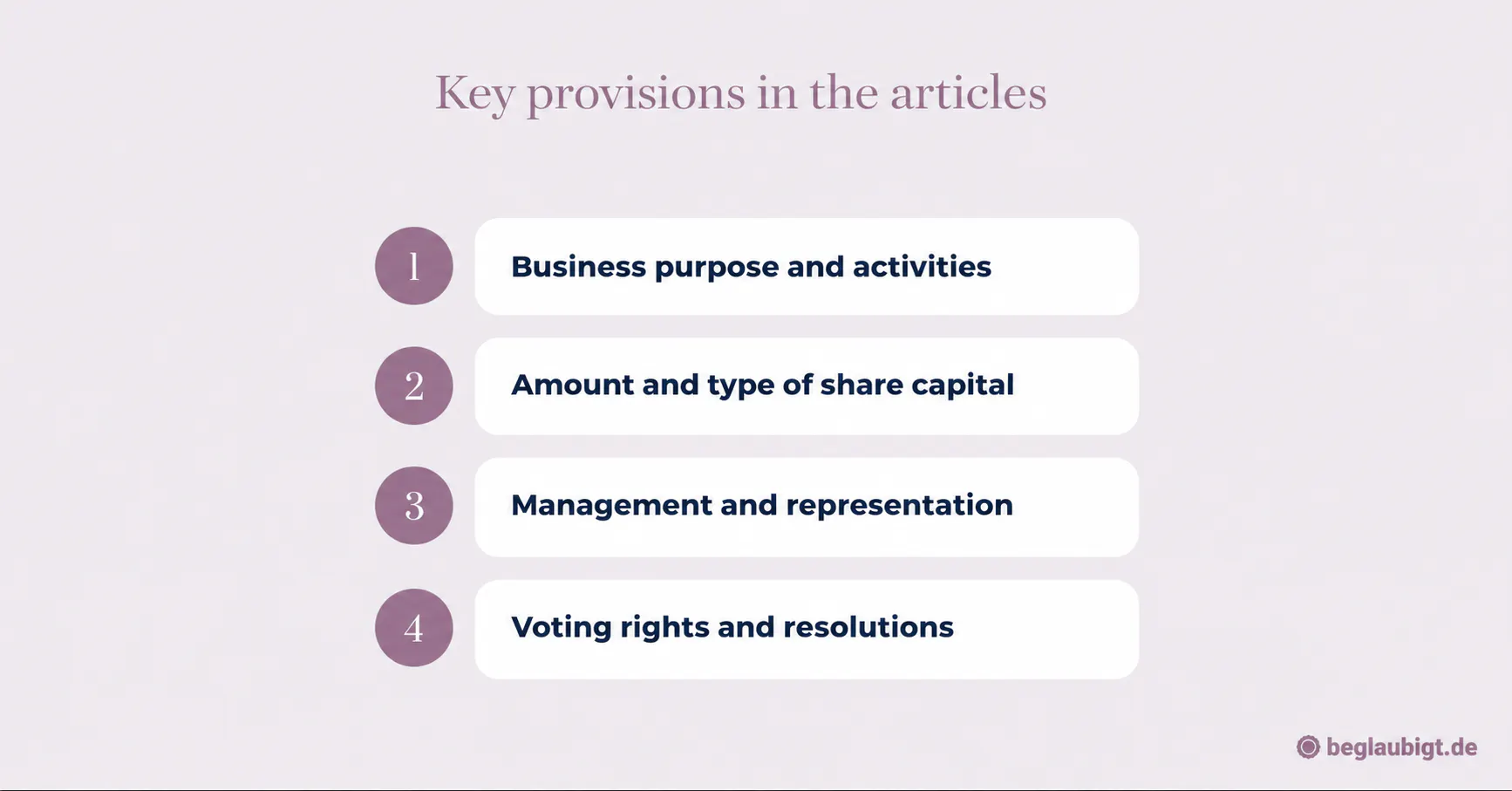
Under § 3 GmbHG, the articles must specify:
- The company’s name.
- Its registered office.
- Its business purpose.
- The amount of share capital.
- The number and nominal amounts of the shares subscribed for by each shareholder.
These provisions establish the basic structure required for registration. The document should identify the company and its ownership arrangements clearly, rather than leave essential details to interpretation. [1]
Simplified examples include:
- Company name: “The company’s name is XYZ GmbH.”
- Registered office: “The company’s registered office is Berlin.”
- Business purpose: “The company’s business purpose is the development and distribution of software solutions.”
- Share capital: “The company’s share capital is €25,000.”
- Allocation of shares: “Shareholder A subscribes for shares numbered 1 to 15, each with a nominal amount of €1,000. Shareholder B subscribes for shares numbered 16 to 25, each with a nominal amount of €1,000.”
The share allocation example is illustrative and is not a complete clause. Stating only that the capital consists of 25 shares of €1,000 does not establish which shareholder subscribes for which shares.
The statutory minimum share capital is €25,000. [12]
Before including the company name in the articles, check its suitability for registration. Our guide to company name requirements under IHK and commercial register rules explains the main considerations.
How should the business purpose be worded?
The business purpose should describe the activities the company intends to carry out with sufficient clarity. It should reflect the actual business model while allowing appropriate room for its development.
Wording that is excessively broad can leave the company’s activities unclear. Wording that is unnecessarily narrow may require an amendment when the business expands. The objective is to describe the core activities accurately, rather than list every conceivable future transaction.
For example, a general phrase such as “trade of every kind” may require further detail. A more informative description would identify the relevant products, services or business area. Whether a particular formulation is sufficiently specific should be discussed with the notary.
An ancillary phrase such as “and all related activities” may complement a clear description, but should not replace it. Where the planned activities involve special regulatory or tax considerations, those matters should also be reviewed before the articles are finalised.
Our guide to the IHK company name check before formation explains how an early assessment can support preparation.
How should management responsibilities and representation be organised?
Management responsibilities and authority to represent the company are different matters. Internal responsibilities determine who handles particular areas of the business. Representation determines who can act for the GmbH in dealings with third parties.
Under § 35(2) GmbHG, several managing directors are generally authorised to represent the company jointly unless the articles provide otherwise. If only one managing director is appointed, that person generally represents the company alone. [3]
An internal allocation might assign finance and personnel to one director and sales and product development to another. That division does not automatically authorise either director to sign alone.
Internal approval requirements must also be distinguished from restrictions effective against third parties. Under § 37 GmbHG, internal limits on a managing director’s authority generally do not restrict their external power of representation. [4]
The documents should therefore coordinate:
- The company’s external representation arrangements.
- The internal division of management responsibilities.
- Transactions requiring shareholder approval.
- Procedures for resolving disagreements between managing directors.
Our article on GmbH share capital with two or more shareholders explores the relationship between ownership and the company’s structure.
How can additional payment obligations be established?
Additional payment obligations, known as Nachschusspflichten, go beyond the original capital contribution. They require an appropriate basis in the articles.
Section 26 GmbHG allows the articles to provide that shareholders may resolve to call for additional payments. The obligation can be limited to a specified amount determined in proportion to the shares. [5]
The wording should make the intended financial commitment clear. Founders should understand whether the obligation is limited, how additional payments are called and which decisions are required. A broadly worded obligation can have significant financial implications.
A clause stating only that shareholders must make additional payments “at the managing directors’ request” should not be adopted without legal review. The articles and the necessary resolution must be considered together.
3. Formal requirements and execution
What formalities must be followed when preparing the articles?
Section 2(1) GmbHG requires the articles to be notarised. The formation arrangements must properly account for all shareholders and any representation under powers of attorney. [2]
The notary’s role extends beyond checking formalities. Under § 17 BeurkG, the notary should establish the parties’ intentions, clarify the facts, explain the legal implications and record their declarations clearly. The notary performs this work independently and impartially. [10]
Additional legal advice can be useful where a shareholder wants their own interests represented in negotiations with the other participants. This is a different function from the notary’s impartial role.
With beglaubigt.de, you can prepare your GmbH formation and coordinate the notary appointment. Whether a video appointment is suitable depends on the proposed transaction and the participants’ identification options.
What role does the commercial register play?
Under § 11 GmbHG, the GmbH does not exist as such before commercial register entry. The period after execution of the formation deed but before entry must therefore be distinguished from the position of the registered company.
Acting in the company’s name during that period can create personal liability under § 11(2) GmbHG. A notarised deed should not be treated as proof that registration has already been completed. [8]
The register court examines whether the company has been properly established and the application properly submitted. Section 9c GmbHG governs refusal of registration, including the circumstances in which defects in the articles justify rejection. Not every disputed or imperfect provision automatically prevents entry. [9]
Clear articles and complete registration documents reduce avoidable uncertainty. They should be prepared alongside the other formation requirements, rather than treated as a document that can be finalised independently of the company’s capital and ownership arrangements.
How can the articles be amended later?
An amendment requires a shareholders’ resolution. Under § 53 GmbHG, the statutory majority is at least three quarters of the votes cast. The articles may impose additional requirements; the threshold cannot simply be reduced at will.
The resolution must be notarised. Where an amendment increases the obligations imposed on shareholders under the articles, § 53(4) GmbHG requires the consent of all shareholders concerned. [6]
Common reasons for amendments include:
- Changing the company name or business purpose.
- Moving the registered office.
- Increasing or reducing share capital.
- Revising shareholder rights or governance arrangements.
The amendment must be filed with the commercial register together with the required updated wording and notarial certification. It takes legal effect only when entered in the register under § 54(3) GmbHG. Notarising the resolution alone does not complete the amendment. [7]
4. Avoiding common drafting mistakes
Which provisions commonly create uncertainty or disputes?
Problems arise when the articles do not explain how important decisions or changes should be handled. A provision may appear clear while the founders agree, yet prove difficult to apply once their interests diverge.
Areas requiring particular attention include:
- The business purpose.
- Voting and approval requirements.
- Share transfer restrictions.
- Arrangements following a shareholder’s departure or death.
- Compensation and valuation provisions.
- Procedures for convening shareholder meetings.
For example, a departure provision may say that a shareholder receives compensation without explaining how it is calculated or when it must be paid. Similarly, requiring agreement on major decisions without addressing a persistent deadlock may leave the company unable to act.
The objective is to make the agreed arrangements workable in the situations they are intended to address. Legal review should consider how the provisions interact, rather than assess each clause in isolation.
Why are unclear management provisions problematic?
The company needs to distinguish internal decision-making from external representation. Uncertainty in either area can disrupt day-to-day operations and create disagreements about responsibility.
An internal allocation of duties should establish who handles each area, how information is shared and which matters require joint decisions. External representation must separately reflect the intended signing arrangements.
Particular care is needed where the founders also act as managing directors. Their ownership rights, management responsibilities and authority to represent the company are separate aspects of the structure. Treating them as interchangeable can leave significant gaps.
Coordinated articles, management rules and any relevant service agreements can help address these matters. However, internal approval requirements should not be assumed to prevent a transaction from binding the company externally. [3] [4]
What happens if the capital provisions are incorrect?
The articles must state the share capital and identify the shares subscribed for by each shareholder. Inconsistent amounts, incomplete allocations or a mismatch between the agreed structure and the formation documents can delay registration and require corrections.
The capital provisions should also correspond to the intended contributions. Different requirements apply where contributions in kind are involved, and an apparent cash contribution should not conceal a different arrangement.
Potential consequences include:
- Requests for clarification or amended documents.
- Delays or refusal of registration where the statutory conditions are met.
- Uncertainty about outstanding contribution obligations.
- Liability risks connected with incorrect statements or defective contributions.
The precise consequences depend on the defect. They should not be reduced to a general assumption that every incorrect capital statement automatically produces the same repayment claim.
A clear allocation of shares and coordinated documentation provide a better basis for formation than relying on a general statement of the total capital. [1] [9] [12]
5. Practical guidance for drafting and maintaining the articles
How much flexibility do the articles offer?
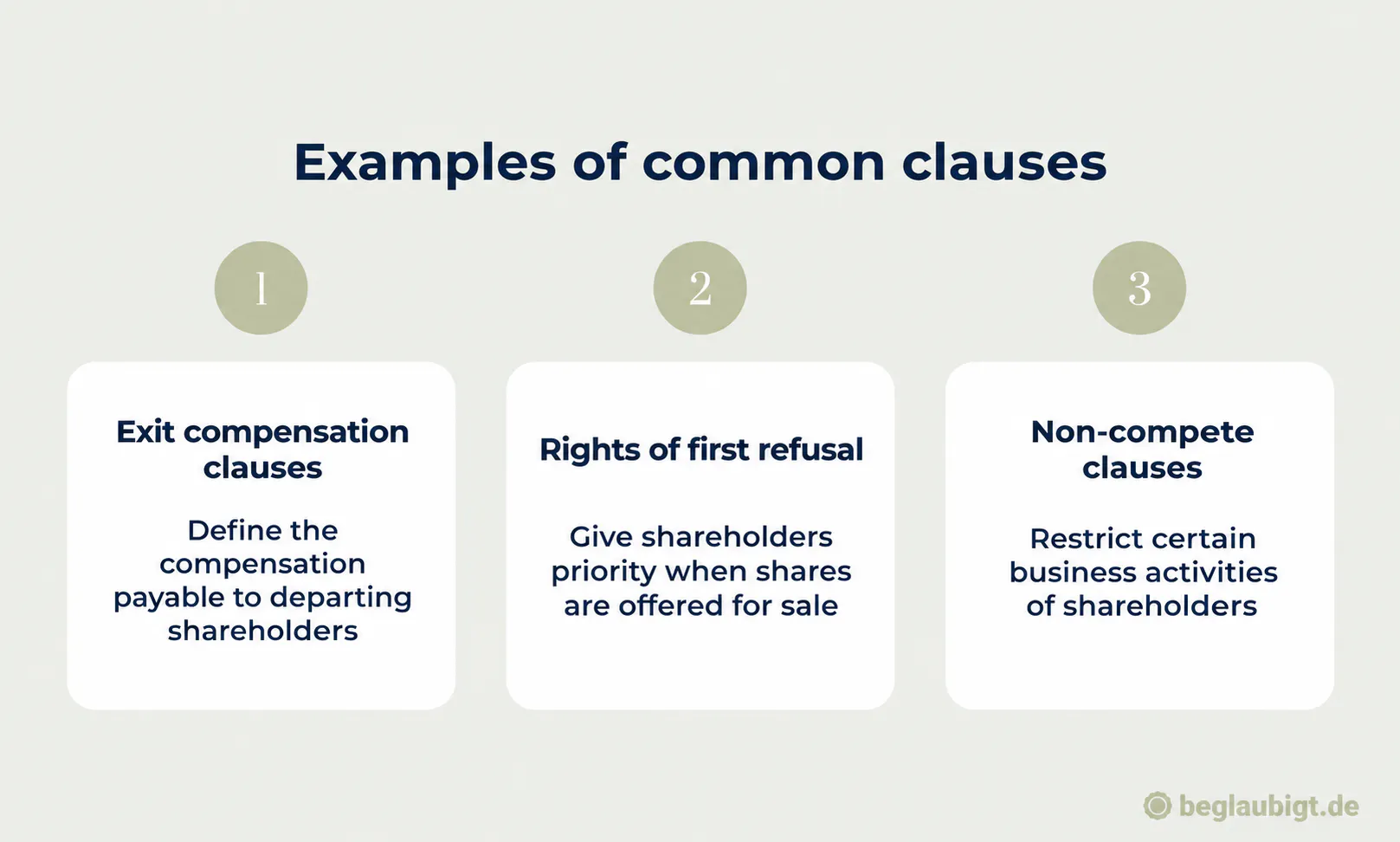
Beyond the mandatory contents, the articles can address the company’s particular organisational requirements. Depending on the structure, this may include decision-making arrangements, rights connected with share ownership, restrictions on transfers and provisions for future changes.
The available flexibility is subject to company law and other applicable legal limits. It should not be described simply as ordinary review under the rules governing standard terms and conditions: § 310(4) BGB contains an exclusion for agreements in the field of company law. That exclusion does not make every provision permissible. [11]
A useful drafting process starts with the company’s actual needs. Which decisions require broad agreement? What should happen if a founder leaves? How might investment affect the existing shareholders? The documents can then be developed around those questions.
When is additional legal advice advisable?
Additional legal advice is particularly useful where shareholders have different interests, the ownership structure is complex or the company anticipates investment or substantial changes.
An adviser acting for an individual shareholder can assess that person’s position and negotiate arrangements on their behalf. This complements the notary’s independent and impartial role.
Issues that may require closer consideration include:
- Additional payment and contribution obligations.
- Voting rights and approval requirements.
- Share transfers and the admission of investors.
- Non-compete provisions.
- Departure, succession and compensation arrangements.
The value of advice lies in identifying how the provisions will operate in practice. A detailed document is not necessarily a suitable document if its rules do not match the business or cannot be applied consistently.
How can the articles accommodate future business needs?
The articles can distinguish between matters requiring a formal amendment and operational arrangements that can be handled through other permitted decisions or documents. For example, a detailed internal allocation of management responsibilities may need to change more frequently than the company’s fundamental structure.
However, flexibility should not be confused with avoiding mandatory amendment requirements. If a change alters the articles themselves, the applicable resolution, notarisation and registration requirements must be followed. [6] [7]
Review the documents when significant developments occur, such as the admission of investors, changes in ownership or a new business strategy. Check whether voting arrangements, transfer provisions and management rules remain consistent with the intended structure.
Where documents are required in another language, confirm the receiving party’s requirements. A translation may support understanding or documentary use, but does not itself guarantee the legal effectiveness of the underlying arrangements.
Conclusion: A sound foundation for your GmbH
The articles of association establish the GmbH’s legal and organisational foundation. They must contain the information required by § 3 GmbHG and comply with the applicable form requirements. Beyond those minimum provisions, they should reflect how the shareholders intend to work together.
Careful drafting is especially important for representation, voting, share transfers and additional payment obligations. Clear arrangements help the founders understand their commitments and reduce uncertainty when the company develops or disagreements arise.
The articles should also be reviewed when the business changes. A document suited to the original founders may need to be adapted before an investment round, ownership change or significant expansion.
Our GmbH formation guide covering the process, costs and duration explains how the articles fit into the wider formation process.
6. Your next step with beglaubigt.de
Prepare your formation with appropriate articles
With beglaubigt.de, you can organise the preparation and coordination of your GmbH formation. The appropriate document model depends on the company’s needs: a model protocol, standardised articles or individual drafting for more specific requirements.
Individual contract drafting within the Priority formation package: €899 plus VAT
The published package includes individually drafted articles and a personal onboarding consultation with a lawyer. This is the price of the formation package, rather than a standalone price for the articles.
Statutory notarial fees and register fees are additional. An independent notary performs the notarisation.
Choose the appropriate GmbH formation package
FAQ about GmbH articles of association
Are “GmbH-Satzung” and “Gesellschaftsvertrag” the same thing?
For a GmbH, both terms commonly refer to the company’s governing document, translated here as its articles of association. It contains the mandatory provisions and can establish additional rules for the company’s organisation and the relationship between shareholders. [1]
What must the articles contain?
Section 3 GmbHG requires the company name and registered office, business purpose, amount of share capital, and the number and nominal amounts of the shares subscribed for by each shareholder. Stating only the aggregate share capital is insufficient; the allocation of shares must also be determined. [1]
Can I prepare the articles myself?
You can compile the intended provisions and agreements yourself, but this does not replace mandatory notarisation. Where several shareholders, special participation rights or future investors are involved, the draft should also be assessed against the intended interests and decision-making arrangements. [2]
Can two shareholders use a model protocol?
The simplified procedure under § 2(1a) GmbHG permits up to three shareholders and one managing director. Two shareholders therefore do not rule it out. Whether it is suitable depends on whether its prescribed provisions are sufficient. Individual arrangements concerning disputes, departures or share transfers cannot be added freely. [2]
Can every managing director sign alone?
Where several managing directors are appointed, § 35(2) GmbHG generally requires joint representation unless the articles provide otherwise. An internal division of duties, such as responsibility for finance or sales, does not itself confer individual signing authority. Internal responsibilities and external representation must therefore be considered separately. [3] [4]
Can the articles be amended later?
Yes. An amendment generally requires a shareholders’ resolution supported by at least three quarters of the votes cast. The articles may impose additional requirements. The resolution must be notarised and the amendment filed with the commercial register. The amendment takes legal effect only upon registration. [6] [7]
Is a certified translation always required?
A translation is not required for every GmbH formation. It may be relevant where foreign-language documents are involved or the articles will be used abroad. Confirm the required language, translation format and supporting documents with the notary or receiving institution. A translation alone does not guarantee the validity of the contents or acceptance for every purpose.
Sources
[1] § 3 GmbHG — Mandatory contents of the articles of association
[2] § 2 GmbHG — Notarial form, model protocols and video notarisation
[3] § 35 GmbHG — Representation of the company
[4] § 37 GmbHG — Internal restrictions and their effect towards third parties
[5] § 26 GmbHG — Additional payment obligations
[6] § 53 GmbHG — Resolution requirements and notarisation of amendments
[7] § 54 GmbHG — Filing and legal effect of amendments
[8] § 11 GmbHG — Legal position before commercial register entry
[9] § 9c GmbHG — Grounds for refusing registration
[10] § 17 BeurkG — The notary’s duties to investigate and explain
[11] § 310(4) BGB — Exclusion for agreements in the field of company law
[12] § 5 GmbHG — Share capital and shares
[13] beglaubigt.de — GmbH formation packages, document models and prices