A GbR and an eGbR are the same German civil-law partnership, with one important distinction: an eGbR is entered in the public partnership register. Registration affects how the partnership demonstrates its ownership and representation arrangements, accesses certain other registers and fulfils disclosure obligations. It does not give the partners limited liability.
For founders and existing partnerships, the practical question is whether registration supports—or is required for—their plans. A small service business has different needs from a partnership buying property or holding GmbH shares. This guide explains the differences, registration costs and ongoing obligations, helping you decide which arrangement fits your business.
Key takeaways in 30 seconds
- Same legal form, different registration status: An eGbR is a registered GbR, rather than a separate type of company.
- Registration is generally voluntary: However, prior registration is required for certain transactions, including relevant land register entries and entry in a GmbH’s shareholder list.
- Personal liability remains: The partners remain personally and jointly and severally liable for partnership debts. Registration does not create a GmbH-style liability shield.
- Registration brings ongoing obligations: Changes to registered details must be reported, and an eGbR must disclose its beneficial owners to the transparency register.
- Trademark ownership is different: An unregistered GbR can also be entered in the trademark register, provided the required applicant information is supplied.
- beglaubigt.de: Explore support for GbR formation and eGbR registration and prepare the appropriate process for your partnership.
These distinctions follow the BGB registration and liability provisions, the rules for the relevant registers and § 20 GwG. [1] [4] [5] [6] [7] [8]
1. Understanding the legal framework
Legal framework: One legal form, two variants
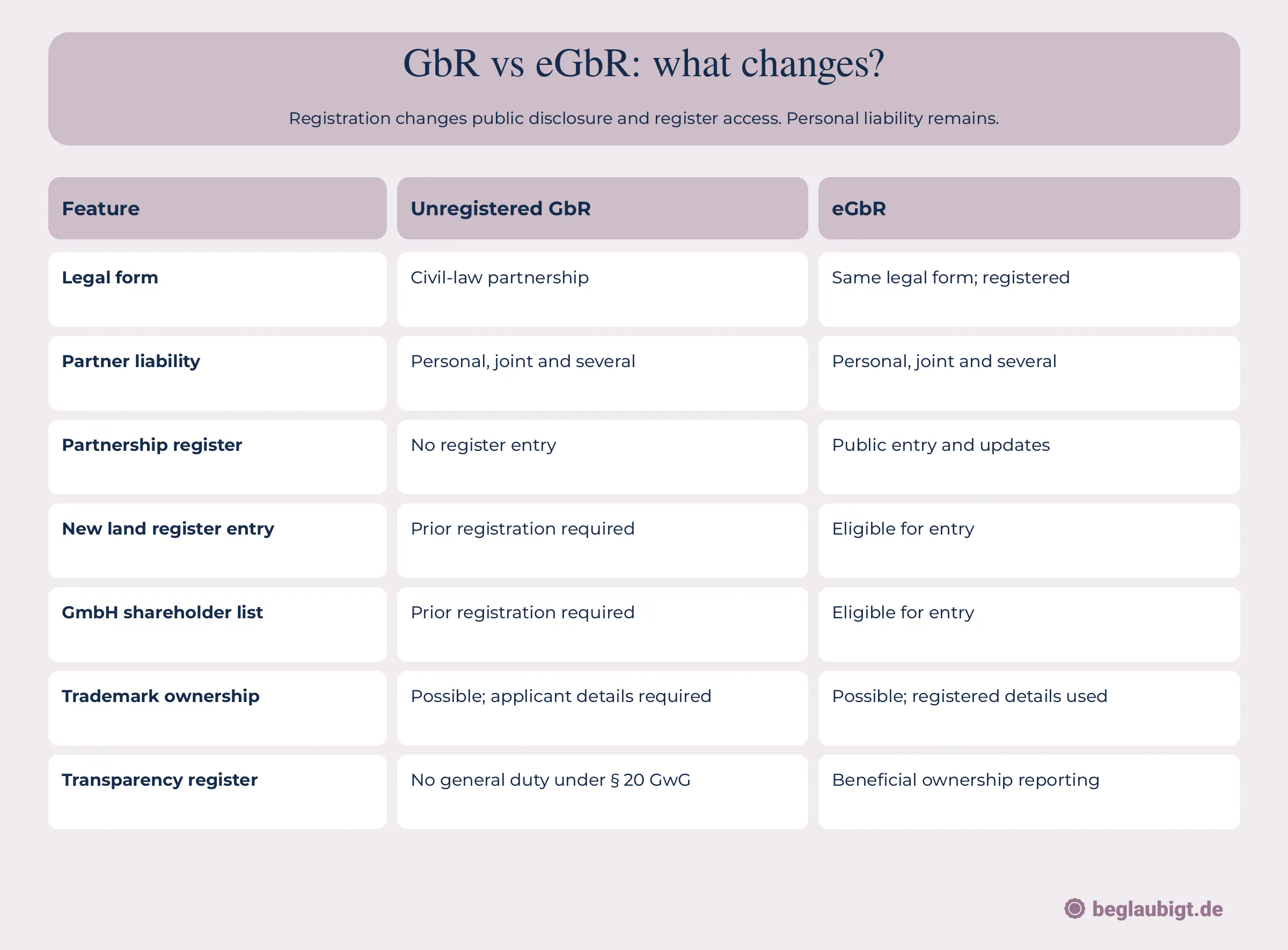
First, the key point: an eGbR is not a separate legal form. A GbR and an eGbR are the same type of partnership under §§ 705 et seq. BGB. The difference is simply whether the partnership is entered in the German partnership register, the Gesellschaftsregister.
Registration is governed by § 707 BGB and is generally voluntary. Any GbR with legal capacity can register; none is automatically required to do so simply because it exists. However, the law attaches significant consequences to registration: only a registered GbR can be entered in other public registers, including the land register, a GmbH’s shareholder list or the trademark register. Lawyers refer to this as the prior-registration requirement.
Once registered, the partnership must include “eGbR” or “eingetragene Gesellschaft bürgerlichen Rechts” in its name (§ 707a BGB). “Muster & Partner GbR” therefore becomes “Muster & Partner eGbR”. Business partners can immediately recognise that a public register extract is available for the partnership, with the reliability that brings.
New: beglaubigt.de offers support throughout the process: Form and register a GbR with beglaubigt.de.
2. Comparing GbR and eGbR in practice
What are the specific differences between a GbR and an eGbR?
In practice, registration makes a difference in five areas, introducing both new possibilities and new obligations:
- Eligibility for other registers: An eGbR can be entered in the land register as a property owner, in a GmbH’s shareholder list as a shareholder and in the trademark register as a trademark owner. Since the introduction of the MoPeG reform, these routes have been closed to unregistered GbRs.
- Name and public identity: An eGbR has a registered name that includes the suffix “eGbR”. It can also use a distinctive business name without including the partners’ names. For an unregistered GbR, this is legally more delicate.
- Public disclosure: Anyone can check the partnership register to see who the eGbR’s partners are and who is authorised to represent it. This builds trust with banks and business partners, but also means that the information is public.
- Changes of partners: For an eGbR, a change of partners is recorded only in the partnership register. The land register and other registers do not need to be amended, which can save substantial costs, particularly for property partnerships.
- Transparency register: An eGbR must report its beneficial owners to the transparency register. An unregistered GbR does not have this obligation.
One point often comes as a surprise: once registered, there is no simple way back. An eGbR cannot be removed from the register whenever its partners choose. Removal is possible only following liquidation or a change of legal status. Registration should therefore be a deliberate decision.
Is an eGbR a separate legal form?
No. A GbR and an eGbR differ only in their registration status, not in their legal nature. Both are partnerships under §§ 705 et seq. BGB, and both have legal capacity: they can enter into contracts, bring legal proceedings and be sued.
Registration also leaves their tax treatment unchanged. An eGbR is treated in the same way as an unregistered GbR: profits are allocated to the partners and taxed at partner level. Our article Does a GbR need its own tax number? explains how this works in detail.
Does registration change liability?
Again, no. The partners of an eGbR have the same liability as those of an unregistered GbR: they are personally liable, without limitation, and jointly and severally (§ 721 BGB).
The small “e” in the name should not be confused with the liability protection of a GmbH. Anyone seeking to exclude personal liability will need a corporate legal form. Our article on GmbH formation costs provides an overview of the costs involved.
3. Understanding registration costs
How much does registering a GbR as an eGbR cost?
Registration does not require a large financial outlay. Most costs are one-off, with a small ongoing charge:
- Notarial fees: The application to the partnership register requires notarial certification. Depending on the number of partners and the work involved, fees under the GNotKG are usually between €60 and €150.
- Court fees: The register court charges approximately €100 for the initial registration.
- Transparency register: Reporting the beneficial owners involves a small annual fee.
- Subsequent amendments: Later changes, such as a change of partners or relocation of the registered office, must also be certified and registered. These incur further fees of a similar order.
Overall, registering as an eGbR typically costs between €150 and €300. Compared with the costs an unregistered property GbR would otherwise incur for land register corrections whenever its partners change, this is manageable. Our article Registering an eGbR: Process, costs and the notary’s role explains each step.
4. The notary’s role in eGbR registration
What role do notaries play in registering an eGbR?
An eGbR cannot be registered without a notary: all partners must participate in the application to the partnership register, and the application requires public certification (§ 707b BGB in conjunction with § 12 HGB). The notary verifies the partners’ identities, prepares the application and submits it electronically to the register court.
The application contains the partnership’s essential details, typically in the following format:
- Court fees: Mustermann Immobilien eGbR
- Registered office: Munich
- Partners: [Names, dates of birth and places of residence of all partners]
- Representation: Each partner is authorised to represent the partnership individually.
For several years now, it has been possible to complete this process without attending a notary’s office in person. The register application can also be certified by video through the Federal Chamber of Notaries’ online procedure. With beglaubigt.de, you can start forming and registering your eGbR online, including a video appointment with the notary.
5. Choosing between a GbR and an eGbR
How do you choose between a GbR and an eGbR?
Whether registration is worthwhile depends on your circumstances. Five questions can help you decide:
- Does the partnership own or intend to acquire property? If so, an eGbR is essential, because a GbR cannot be entered in the land register without prior registration. This also applies to existing property GbRs when a transaction affecting the property is planned.
- Will the partnership hold shares in other companies? A GbR wishing to acquire GmbH shares or be entered in a GmbH’s shareholder list also needs to register as an eGbR first.
- How important is the partnership’s public identity? A register extract that any business partner can obtain builds trust. An eGbR has an advantage when dealing with banks, landlords and larger clients.
- How often do the partners change? Where changes are frequent, for example in larger partnerships, an eGbR reduces ongoing administration because only one register needs to be updated.
- How do you feel about public disclosure? If you do not want the partners’ details and representation arrangements to be publicly accessible, and the partnership holds no assets requiring registration, an unregistered GbR offers a simpler structure without register costs or transparency register obligations.
As a rule of thumb, a conventional GbR will almost always be sufficient for a shared office arrangement or a small service business without property or company shareholdings. Once assets requiring entry in a register are involved, an eGbR becomes more than a useful option: it is effectively necessary.
6. Conclusion
Know the difference
A GbR and an eGbR are two variants of the same partnership, with a distinction that has significant practical consequences. Registration in the partnership register gives a GbR access to the land register, shareholder lists and the trademark register, along with a registered name and a more readily verifiable public identity.
In return, the partnership takes on public disclosure obligations, beneficial ownership reporting and an ongoing connection to the register from which it cannot simply withdraw. Registration does not, however, change its liability or tax treatment.
Ultimately, the decision depends on what the partnership intends to do over the coming years. Without assets that require registration, a conventional GbR remains the simplest option. With property or company shareholdings, an eGbR is essential—so it makes sense to arrange registration properly from the outset rather than face a delayed notarial transaction under time pressure later.
If you decide on an eGbR, our GbR formation page explains the process step by step. You can start the formation process directly online.
Your next step with beglaubigt.de
Once you have established whether your partnership needs registration, the next step is to prepare its details and the required documents. With beglaubigt.de, you can organise support for your GbR formation or eGbR registration, including coordination of the necessary notarial steps.
eGbR formation support: €399 plus VAT
The published eGbR package includes a partnership agreement and coordination of the partnership register application and relevant administrative registrations. Statutory notarial fees and register fees are additional.
The independent notary performs the required certification, and the competent register court decides on registration.
Start preparing your eGbR registration
FAQ about GbR and eGbR in Germany
Is an eGbR a separate legal form?
No. An eGbR is a GbR entered in the partnership register. Registration changes its public registration status and introduces associated obligations, but the partnership remains governed by the GbR provisions of the BGB. The suffix “eGbR” identifies that registered status. [1] [3]
Does registering as an eGbR protect my personal assets?
Registration does not limit the partners’ statutory personal liability. Under § 721 BGB, partners are personally liable for partnership debts as joint and several debtors. An internal agreement allocating responsibilities between partners does not, by itself, remove that liability towards creditors.
Our guide to personal liability in a GbR explains the practical risks in more detail. [4]
Does a GbR need to register before buying property?
For a right to be entered in the land register in the name of a GbR, § 47(2) GBO requires prior entry in the partnership register. Registration should therefore be coordinated with the notary before a planned property acquisition.
An existing unregistered property GbR should also discuss the registration requirements before a transaction affecting its registered rights. [5]
Must a GbR become an eGbR to own a trademark?
No. An unregistered GbR can also be entered in the trademark register. Under § 5 MarkenV, its application must additionally identify at least one partner authorised to represent it, including that partner’s name and address.
The prior-registration requirements for land register entries and GmbH shareholder lists should therefore not be applied indiscriminately to trademarks. [7]
Can the register application be certified online?
Yes. Applications to the partnership register are among the procedures permitted through the German notarial online system. Participants must satisfy the identification and technical requirements, including suitable electronic identification and the required official digital photograph.
An ordinary video call or a passport alone does not replace the prescribed identification procedure. Discuss eligibility before booking the appointment. [11] [12] [15]
Can an eGbR simply cancel its registration later?
Registration cannot be withdrawn merely because the partners would prefer to operate without a public entry. Section 707a(4) BGB provides that deletion follows the general legal rules. The partnership’s future plans and disclosure obligations should therefore be considered before registering. [3]
Sources
[1] § 705 BGB — Legal nature and legal capacity of a civil-law partnership
[2] § 707 BGB — Application to the partnership register and subsequent changes
[3] § 707a BGB — Effects of registration, naming requirements and deletion
[4] § 721 BGB — Personal liability of partners
[5] § 47 GBO — Prior registration for land register entries
[6] § 40 GmbHG — Prior registration for entry in a GmbH’s shareholder list
[7] § 5 MarkenV — Trademark applicant details, including unregistered GbRs
[8] § 20 GwG — Beneficial ownership reporting obligations
[9] HRegGebV, fee schedule — Register fees, particularly items 1101, 1102 and 6000
[10] § 707b BGB — Application of commercial register provisions
[11] § 12 HGB — Electronic submission and public certification
[12] Bundesnotarkammer — Technical and identification requirements for online procedures
[13] GNotKG — Statutory court and notarial costs
[14] beglaubigt.de — GbR and eGbR service packages and prices
[15] Bundesnotarkammer — Permitted online notarial procedures