You can form a GmbH in Germany through an online notarial procedure if the transaction and participants meet the legal requirements. You will need suitable electronic identification, formation documents and share capital. The company becomes a GmbH upon commercial register entry; the video appointment is one stage of that process. [1] [4]
For founders, the main challenge is coordinating the steps around the appointment: choosing the right articles, opening a business account, paying in capital and preparing a complete register application. International founders may also need foreign corporate documents, translations or an alternative to electronic identification. This guide explains how those pieces fit together, what to budget and how to prepare for a smoother formation.
Key takeaways in 30 seconds
- Online formation still involves a German notary. Eligible formation deeds can be notarised by video through the official notarial system.
- A GmbH requires at least €25,000 in share capital. For a standard cash formation, registration can generally be requested once at least €12,500 has been contributed and the minimum contribution to each share has been met.
- A passport alone does not replace an eligible eID. Electronic identity verification and the official digital photograph are separate requirements.
- Costs and timelines have several components. Notarial fees, register fees and any private service fee are separate; banking and court processing affect the overall schedule.
- beglaubigt.de: Explore the GmbH formation service to organise the preparation and coordination of your formation.
The capital and identification requirements follow § 5 and § 7 GmbHG and § 16c BeurkG.
1. Understanding online GmbH formation
What does forming a GmbH online actually mean?
A GmbH, short for Gesellschaft mit beschränkter Haftung, is a German limited liability company. Online formation changes how the notarial appointment takes place. Instead of meeting everyone in the notary’s office, eligible participants attend by video, complete the prescribed identity checks and sign electronically within the notarial procedure.
The legal basis is § 2(3) GmbHG. Online notarisation is available where no other formal requirements prevent it, and it can accommodate individually drafted articles as well as statutory model documents. This makes it relevant to founders who need more than a basic template. [1]
However, completing an online application form does not establish the company. The notarial deed, capital contributions and commercial register application remain distinct stages. Under § 11 GmbHG, the GmbH does not exist as such before registration. Founders should therefore distinguish between having signed the formation deed and having an incorporated company. [4]
Can every GmbH be formed online?
Both cash formations and certain formations involving contributions in kind can use the online procedure. The deciding question is whether the particular transaction can satisfy all applicable formal requirements. Assets whose transfer involves additional formalities may require a different approach.
The notary must also be able to fulfil their official duties remotely. Under § 16a BeurkG, the notary should decline video notarisation if that cannot be ensured—for example, if identity or legal capacity cannot be established adequately. Check the proposed ownership structure, contributions and participants before treating an online appointment as confirmed. [13] [26]
2. Preparing the company and its documents
Which company details should you decide first?
Before drafting begins, agree on the company name, registered office, business purpose, share capital and the allocation of shares. These are core elements of the articles under § 3 GmbHG. Decide who will act as managing director and how the company should be represented, particularly if more than one director will be appointed. [5]
These decisions deserve more attention than an appointment booking. Two founders may agree on a 50/50 ownership split without having discussed what happens if they disagree, one leaves or further investment becomes necessary. Raising those questions during preparation gives the notary and any adviser a clearer brief and reduces the likelihood of last-minute changes.
For the name, distinguish a company-name assessment from a trademark search. Our guide to the IHK company name check explains what the chamber’s preliminary assessment covers and why the register court still makes the registration decision.
What documents will you need?
The precise list depends on the participants and ownership structure. A straightforward formation by individuals usually requires identification documents, personal details, the agreed company information and details of the intended directors. The notary prepares the necessary formation and registration documents from that information.
A corporate shareholder adds another layer. The notary needs evidence of the company’s existence and of the authority of the person acting for it. Where documents come from abroad, ask which extracts, certifications and translations are required before ordering them. A downloadable extract that is sufficient for an internal business check may not satisfy the requirements of a notarial or register procedure.
For registration, § 8 GmbHG specifies documents including the articles, evidence of the directors’ appointment where necessary and the shareholder list. Powers of attorney and additional contribution documents may also be relevant. [7]
Do you need a German address?
The registered office specified in the articles must be in Germany under § 4a GmbHG. The register application must also state a domestic business address under § 8(4) GmbHG. These are related but different details: the registered office identifies the municipality, while the business address provides the company’s address for registration and service. [6] [7]
Arrange an address the company is entitled to use and ensure that official correspondence reaches the responsible people reliably. A low-cost postal service should be assessed against its actual permitted uses, rather than assumed to satisfy every requirement of the register court, bank and tax office.
3. Meeting the eID and technical requirements
Which identification documents work for online formation?
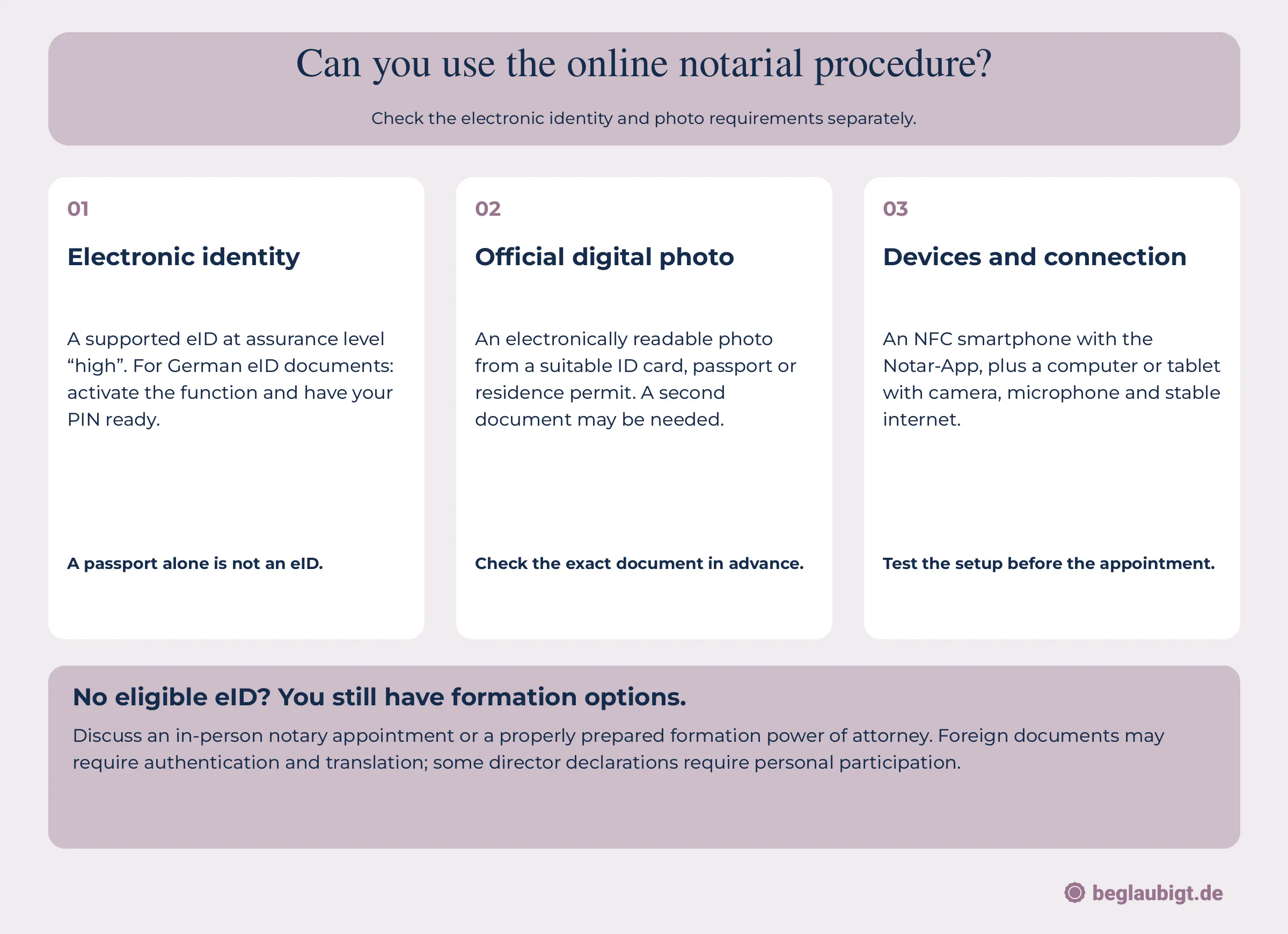
The online notarial procedure generally combines an eligible electronic identity with an electronically retrieved official photograph. These fulfil different functions, even when one document can provide both. The legal framework is § 16c BeurkG. [9]
Potentially suitable electronic identities include a German identity card with the online function activated, a suitable electronic residence permit, the German eID card for eligible EU/EEA citizens and supported foreign electronic identification means. Foreign eIDs must meet the required assurance level and recognition conditions; an ordinary identity card from an EU country is not automatically sufficient. Check the current supported documents and any technical restrictions before scheduling the appointment. [10] [12]
For German identity cards, the issue date matters for the photograph. A card issued on or after 2 August 2021 can generally provide the required digital photo. An older German identity card may still provide the eID function, but an additional suitable passport is normally needed for the photograph. A suitable electronic residence permit can also provide the photo; the same issue-date rule should not simply be applied to every document type. [11]
A passport alone does not replace the required eID. It may supply the digital photograph while a separate document supplies the electronic identity. Our guide to identification documents for online notarisation explains these combinations in more detail.
What equipment should you prepare?
You will generally need an NFC-enabled smartphone with the Notar-App, together with a computer or tablet equipped with a camera, microphone and stable internet connection. For German eID documents, check that the online identification function is active and that you know the relevant PIN.
Test the setup before the appointment. A missing PIN, an unreadable document chip or an unsuitable device can interrupt the process even when the company documents are ready. Each person participating remotely should check their own documents and equipment. [10]
What happens if you do not have an eligible eID?
You can discuss an in-person appointment with the notary. Another possible route is representation under a properly prepared formation power of attorney. Under § 2(2) GmbHG, signing the articles through a representative requires a notarised power of attorney or one with a notarised signature. [1]
For a power of attorney executed abroad, have the German notary approve the wording and required form first. Depending on the country and document, authentication and translation may be needed. An apostille confirms specified aspects of a public document’s authenticity; it does not by itself confirm that the wording or transaction satisfies German formation requirements. [23]
Representation must also be considered separately for the shareholder’s formation declaration and the managing director’s personal declarations. A formation power of attorney should not be assumed to cover every act required to register the company.
4. Choosing the articles and completing notarisation
Should you use a model protocol or tailored articles?
A model protocol combines prescribed formation provisions in a standard document. It can be suitable for a simple structure with no need for negotiated governance rules. The simplified procedure under § 2(1a) GmbHG is limited to three shareholders and one managing director; the law also provides separate model documents for video formation. [1]
Tailored articles become more useful when the founders need rules about voting, share transfers, departures, succession or deadlocks. For example, equal ownership may feel straightforward at the beginning, but two shareholders with opposing views can prevent decisions unless the structure provides a workable solution. Discuss the expected relationship between the founders rather than choosing solely on the initial drafting cost.
You can prepare your GmbH formation with beglaubigt.de. The notarial work is performed by an independent notary.
What happens during the online notary appointment?
The notary establishes the participants’ identities, explains the deed and its legal implications, and conducts the prescribed reading and approval process. Participants sign electronically within the official procedure. This is a regulated notarial appointment, rather than an ordinary video call followed by uploading a scanned signature.
Resolve commercial questions beforehand wherever possible. If the founders are still negotiating ownership or control, the appointment may need to be postponed while the documents are revised. International participants should also discuss language needs early, including whether an interpreter or translations will be required. [27]
5. Opening the account and paying in share capital
When should you open the business account?
For a typical cash formation, the sequence is to execute the formation deed, open an account for the GmbH in formation and pay the required capital before the register application is submitted. You should research the bank’s eligibility criteria earlier, particularly where shareholders or directors live abroad.
The bank carries out its own identity, authority and beneficial ownership checks. Successful identification for the notarial procedure does not guarantee that a bank will accept the company. Ownership chains, countries involved and the proposed business activity can affect the documents requested and processing time. [14]
Our guide to opening a GmbH business account covers authorised representatives, documents and the relationship between account opening and registration.
Do you need the full €25,000 immediately?
The minimum share capital is €25,000. For a cash formation, at least one quarter of each share’s nominal amount must be paid before filing, and total cash contributions must reach at least €12,500. These are cumulative conditions, so an uneven contribution arrangement should be checked carefully. [2] [3]
For example, two shareholders each taking a €12,500 share could each pay €6,250 initially. That meets the total requirement while exceeding the quarter-per-share minimum. The unpaid balance remains owed; partial initial payment does not reduce the subscribed capital to €12,500.
Keep clear payment records and follow the notary’s instructions before filing. For further practical detail, see paying share capital into a GmbH.
Can the company use the capital after registration?
Share capital is company funding, rather than a formation fee. It does not generally have to remain untouched in the bank account indefinitely. However, using company money for business purposes differs from returning it to shareholders.
Capital maintenance rules, including § 30 GmbHG, restrict distributions to shareholders. Formation expenses also require appropriate treatment, including consideration of what the articles allow the company to bear. Plan the company’s liquidity with an adviser so that paying setup bills does not leave it unable to meet its operating obligations. [24]
6. Understanding the costs of online GmbH formation
Which costs should your budget include?
Separate the subscribed capital from the expenses of establishing and operating the company. The main formation expenses are statutory notarial fees, register fees and any private formation service you choose. Depending on the case, there may also be costs for translations, authentication, interpreters or legal advice outside the notarial work.
Notarial fees are governed by law. Their amount depends on the transaction and relevant calculation rules, rather than whether the appointment takes place in an expensive city. The official Notar.de examples include €630 in notarial fees for a multiple-shareholder GmbH with €25,000 capital and appointment of the managing director, before expenses and VAT. That example should not be treated as a universal quote. [15]
For online procedures, the official fee guidance also identifies video-system charges of €25 per notarisation procedure and €8 per signature-certification procedure, plus VAT. These are additional expense items, rather than the full notary bill. [28]
How much are the commercial register fees?
For a standard first registration of a cash-funded GmbH, the fee schedule lists €225 under item 2100. Item 6000 adds one third for making the register information available, producing a combined amount of €300 for these items.
Different transactions can trigger different fees. Contributions in kind, later amendments and additional register procedures should therefore be checked separately. [16]
What does an illustrative calculation look like?
Using the official multiple-shareholder notarial example:
€630 notarial fees + €119.70 VAT + €300 register fees = €1,049.70.
This is a subtotal before notarial expenses, applicable video charges and any private formation service. It also excludes translations, authentication, banking, address services and ongoing accounting. Its purpose is to show how the components fit together, rather than predict an individual invoice.
For planning, obtain a case-specific calculation and identify who pays each item. Avoid automatically adding all expenses to the capital as though the capital could never fund legitimate company expenditure; equally, do not assume every founder’s private setup expense may be charged to the company.
What do the beglaubigt.de packages cost?
The published service prices are €249 plus VAT for Einfach, €399 plus VAT for Standard and €899 plus VAT for Priority. At 19% VAT, these are €296.31, €474.81 and €1,069.81 respectively.
Einfach uses a model protocol, Standard provides standardised articles, and Priority addresses individual contracts and more complex structures. Statutory notarial and register fees are additional. [18]
7. Following the process through to registration
What are the main stages?
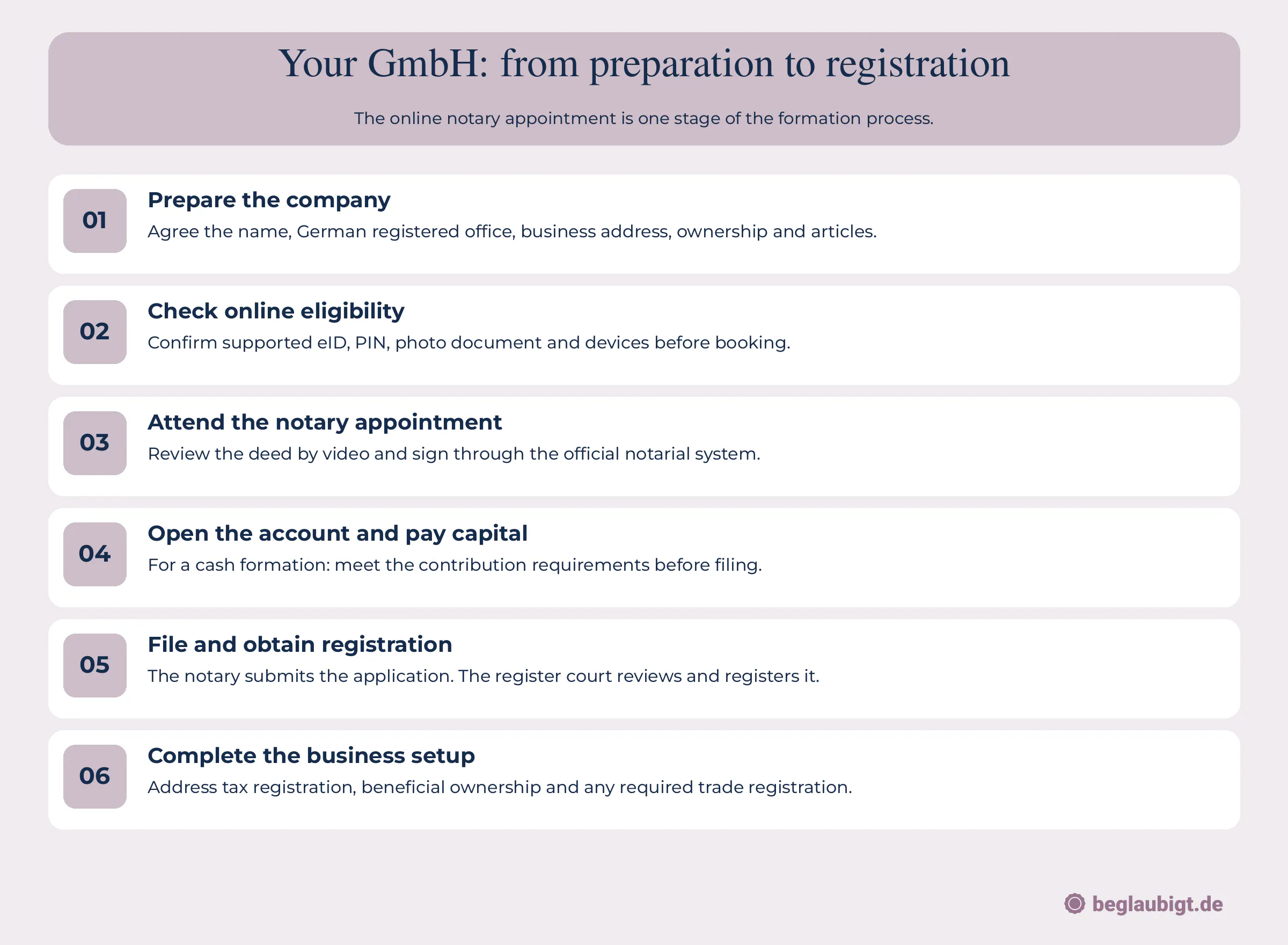
Step 1: Settle the structure. Agree the company details, shareholders, directors, contributions and type of articles. Flag foreign documents and representation arrangements immediately.
Step 2: Confirm online eligibility. Check each remote participant’s eID, photo document and equipment before relying on a video appointment.
Step 3: Complete notarisation. Review the drafts beforehand and attend the appointment with the commercial decisions already agreed.
Step 4: Complete banking and capital contributions. Satisfy the bank’s checks, pay the required contributions and provide the information the notary requests.
Step 5: Submit the register application. The notary handles the filing; the register court examines whether the requirements for entry are met. Respond promptly through the notary if clarification or corrections are requested.
Step 6: Complete the wider business setup. Coordinate the remaining registrations, accounting arrangements and any permissions required for the intended activity.
For the broader formation framework, our GmbH formation guide covering process, costs and duration provides additional detail in German.
How long does online GmbH formation take?
There is no reliable universal duration covering preparation, banking, registration and tax administration. A straightforward case with complete documents can progress much faster than one involving unresolved articles, foreign corporate shareholders or additional identity checks. Plan around milestones and ask what each quoted timeframe actually covers.
For qualifying online formations, § 25(3) HRV provides for registration generally within ten working days after receipt of a complete application, or after a remediable obstacle has been resolved. The period is five working days where the specified conditions concerning natural-person shareholders and statutory model protocols are met. These periods concern the register stage, rather than the entire formation project. [17]
The beglaubigt.de package descriptions refer to a notary appointment within seven working days. That should be distinguished from completed court registration.
8. Forming a GmbH as an international founder
Must the managing director live in Germany?
German GmbH law does not impose a general German residence or citizenship requirement for managing directors. Section 6 GmbHG instead sets requirements concerning natural-person status, legal capacity and disqualifying circumstances. The company’s German registered office and domestic business address remain separate requirements. [8]
Practical arrangements still matter. A director living abroad must be able to manage the company’s obligations, communicate with advisers and receive important correspondence. Discuss the proposed management arrangements with the notary and tax adviser. If the director intends to relocate or work physically in Germany, clarify the applicable immigration requirements with the competent authority before relying on company formation as part of that plan.
How should you prepare foreign documents?
Ask the receiving notary what is needed for each document and issuing country. The answer may involve an apostille, legalisation, another verification procedure or an exemption. Translation is a separate issue: an authenticated document may still need an appropriate German translation.
Allow time for obtaining documents and checking names, representation rules and ownership chains. Ordering authentication before the German notary has confirmed the required document can create unnecessary work. The Federal Foreign Office explains the different authentication routes and their limits. [23]
9. Completing registrations and ongoing administration
Which obligations remain beyond the commercial register?
Plan the tax registration alongside the formation process. The tax registration questionnaire supplies information the tax office needs to assess the company and issue its tax number. Section 138 AO governs relevant notification and information duties; do not assume that commercial register entry completes tax registration automatically. [19]
The company’s Steuernummer, its commercial register number and a VAT identification number are different identifiers. Where a VAT identification number is required, a newly established business can request it through the tax registration questionnaire. [22]
Also address any required trade registration under § 14 GewO and beneficial ownership reporting under § 20 GwG. The latter requires relevant information to be obtained, maintained and reported to the transparency register. Assign responsibility for each task, whether it is handled internally, by an adviser or within a selected service package. [20] [21]
What should you organise for ongoing compliance?
Set up bookkeeping from the outset, including a process for invoices, receipts, payments and records. Section 238 HGB establishes the commercial bookkeeping obligation. Discuss financial reporting, tax returns and any further obligations with an adviser rather than waiting until the end of the first financial year.
A realistic operating budget should therefore cover more than formation. Banking, accounting, business premises or address services, insurance and professional advice may continue after the registration invoice has been paid. [25]
10. Your next step with beglaubigt.de
Prepare your GmbH formation with a clear plan
With beglaubigt.de, you can organise the digital preparation and coordination of your GmbH formation. Start by confirming your structure, identification documents and required support.
GmbH formation support from €249 plus VAT
Statutory notarial fees, register fees and share capital are additional. The independent notary conducts notarisation; the register court decides on entry.
Start your GmbH formation with beglaubigt.de
FAQ about online GmbH formation in Germany
Can I form a GmbH entirely online?
The formation deed can be notarised online where the legal and identification requirements are met. Banking, foreign document preparation or other circumstances may still involve additional steps. Confirm the route for your particular structure before assuming that every task can be completed remotely.
Can one person form a GmbH online?
Yes. A single-founder structure can use the online notarial procedure where the relevant requirements are satisfied. The founder may also be the managing director, provided the appointment requirements are met. Document choice and representation arrangements should be discussed with the notary.
Can I use only my passport?
A passport alone does not replace the required electronic identity. It may provide the official digital photograph alongside a separate eligible eID. Check both requirements and the technical compatibility of the documents before the appointment.
Is €12,500 enough to form a GmbH?
For a cash formation, €12,500 can satisfy the total initial contribution requirement if the minimum payment on each share is also met. The subscribed capital remains at least €25,000, and unpaid contributions remain owed. Formation expenses and adequate operating liquidity must be considered separately.
Can I sign contracts before registration?
There can be legal consequences for acting before entry. Under § 11(2) GmbHG, persons acting in the company’s name before registration can incur personal and joint liability. Discuss significant commitments with the notary or an adviser rather than assuming that signing the formation deed already provides the usual GmbH liability position. [4]
Is online formation cheaper than an in-person appointment?
Online formation does not remove statutory notarial fees. It may reduce travel and coordination costs, while applicable video-system expenses are added to the notarial bill. Compare the full scope of the transaction and any service package, rather than treating the appointment format as the sole cost factor.
Does a formation service replace the notary?
No. A private formation service can assist with preparation and coordination. The legally reserved notarial work remains with the independent notary, and registration remains the responsibility of the competent register court.
Sources
[1] § 2 GmbHG — Form of the articles, representation and online formation
[2] § 5 GmbHG — Share capital and shares
[3] § 7 GmbHG — Capital contributions before registration
[4] § 11 GmbHG — Legal position before registration
[5] § 3 GmbHG — Required content of the articles
[6] § 4a GmbHG — Registered office
[7] § 8 GmbHG — Registration documents, declarations and domestic business address
[8] § 6 GmbHG — Managing directors
[9] § 16c BeurkG — Identification in notarial video procedures
[10] Bundesnotarkammer — Technical and identification requirements
[11] Bundesnotarkammer — Documents for reading the digital photograph
[12] Bundesnotarkammer — Suitable foreign electronic identification documents
[13] Bundesnotarkammer — Permitted online notarial procedures
[14] § 10 GwG — Customer due diligence and beneficial ownership checks
[15] Bundesnotarkammer / Notar.de — Official notarial cost examples
[16] HRegGebV, fee schedule — Commercial register fees, including items 2100 and 6000
[17] § 25 HRV — Processing periods for qualifying online registrations
[18] beglaubigt.de — GmbH formation packages, service prices and provider information
[19] § 138 AO — Tax notification and registration information
[20] § 14 GewO — Trade notification requirements
[21] § 20 GwG — Beneficial ownership reporting
[22] Federal administration portal — Applying for a VAT identification number
[23] Federal Foreign Office — International authentication of public documents
[24] § 30 GmbHG — Capital maintenance
[25] § 238 HGB — Commercial bookkeeping obligations
[26] § 16a BeurkG — Admissibility of video notarisation
[27] Bundesnotarkammer — How the online notarial procedure works
[28] Bundesnotarkammer — Additional fees for online procedures