You apply for an apostille through the authority responsible for your document in the country where it was issued. In Germany, depending on the document, this may be a state authority, a judicial authority or the Federal Agency for Foreign Affairs. Birth certificates, certificates of conduct and Commercial Register extracts therefore follow different procedures. The overall timeframe depends on preparation, processing and delivery. [1]
You want to get married abroad, apply for professional registration or open an account for your company. The receiving organisation asks for a document “with an apostille”—but the document itself does not tell you which authority to contact. The first question is who issued it. Your current place of residence or your company’s location does not automatically determine which authority is responsible.
The destination country is equally important. An apostille is only the appropriate route if the relevant Convention applies between that country and the country of issue, and no exemption applies. Certain documents used within the EU may not need one. In other circumstances, legalisation or another form of authentication may be required. Only then can you establish the required document format and how much time to allow.
With the apostille service from beglaubigt.de, you can arrange support with preparing and obtaining the required apostille. The apostille itself is issued exclusively by the competent public authority. This guide explains the procedure for each document type and how to avoid unnecessary queries and additional postal journeys.
Key takeaways in 30 seconds
- Birth certificate: A state authority responsible for administrative documents will generally handle the apostille. The specific authority depends on the federal state and the issuing body.
- Certificate of conduct: The Federal Office of Justice issues the certificate and prepares it for use abroad. The Federal Agency for Foreign Affairs issues the apostille.
- Commercial Register extract: You need the appropriate official or certified version. The competent judicial authority issues the apostille; depending on the state’s rules, this may be a local court or a regional court.
- Check the destination country first: An apostille is not required for every country or every procedure. Exemptions can save additional steps.
- Have the original or an appropriate official version ready: A scan or a simple register download is not automatically sufficient for a paper-based apostille procedure.
- There is no single processing time across Germany: Published processing times range from a few working days to several weeks. Obtaining the document and delivery must also be factored in.
- An apostille is not a translation: It confirms certain authenticity features of a public document, rather than the accuracy of its contents or all its legal effects abroad.
- beglaubigt.de: When preparing your apostille application, provide the document type, issuing body and destination country so that the appropriate procedure can be agreed.
1. At what state you need an apostille
What does an apostille certify—and what does it not certify?
An apostille simplifies the authentication of public documents for international use. In particular, it certifies the authenticity of a signature, the capacity in which the person signing acted and, where applicable, the identity of a seal or stamp. It is based on the Hague Convention of 5 October 1961. The certificate is issued by a designated authority in the country from which the document originates. [1] [2]
An apostille does not, however, generally verify the document’s contents. It does not turn a private statement into an officially established fact, nor does it replace a translation or all other requirements imposed by the receiving organisation. Ask which document is needed, in what form, and whether a translation or a recently issued version is also required. Our overview of certification, notarisation, apostilles and legalisation explains the distinctions.

Do documents used within the EU always need an apostille?
No. Regulation (EU) 2016/1191 exempts certain public documents from the apostille requirement when they are presented to authorities in another EU Member State. The areas covered include birth, marriage and other civil-status matters. However, the Regulation does not apply to every document or every recipient. A Commercial Register extract does not qualify for this exemption simply because it will be used within the EU. [3]
For example, if you need to present a German birth certificate to an authority in another EU Member State, check this exemption first. Under certain conditions, a multilingual standard form may also help with translation requirements. Separate rules apply to recognition of the document’s legal effects and other substantive requirements. Where no exemption applies, establish whether the Apostille Convention operates between the countries concerned or whether another form of authentication is needed. The country guide to apostilles and legalisation provides an initial overview.
2. An overview by document type
Which authority is responsible for which document?
Germany does not have one apostille authority for every type of document. Documents issued by federal authorities, administrative documents issued by state and municipal authorities, and judicial or notarial documents fall under different responsibilities. Start with the issuing body. It can generally tell you which apostille authority is responsible and what form the document must take.
An authority near your current home does not become responsible simply because it is easier for you to reach.
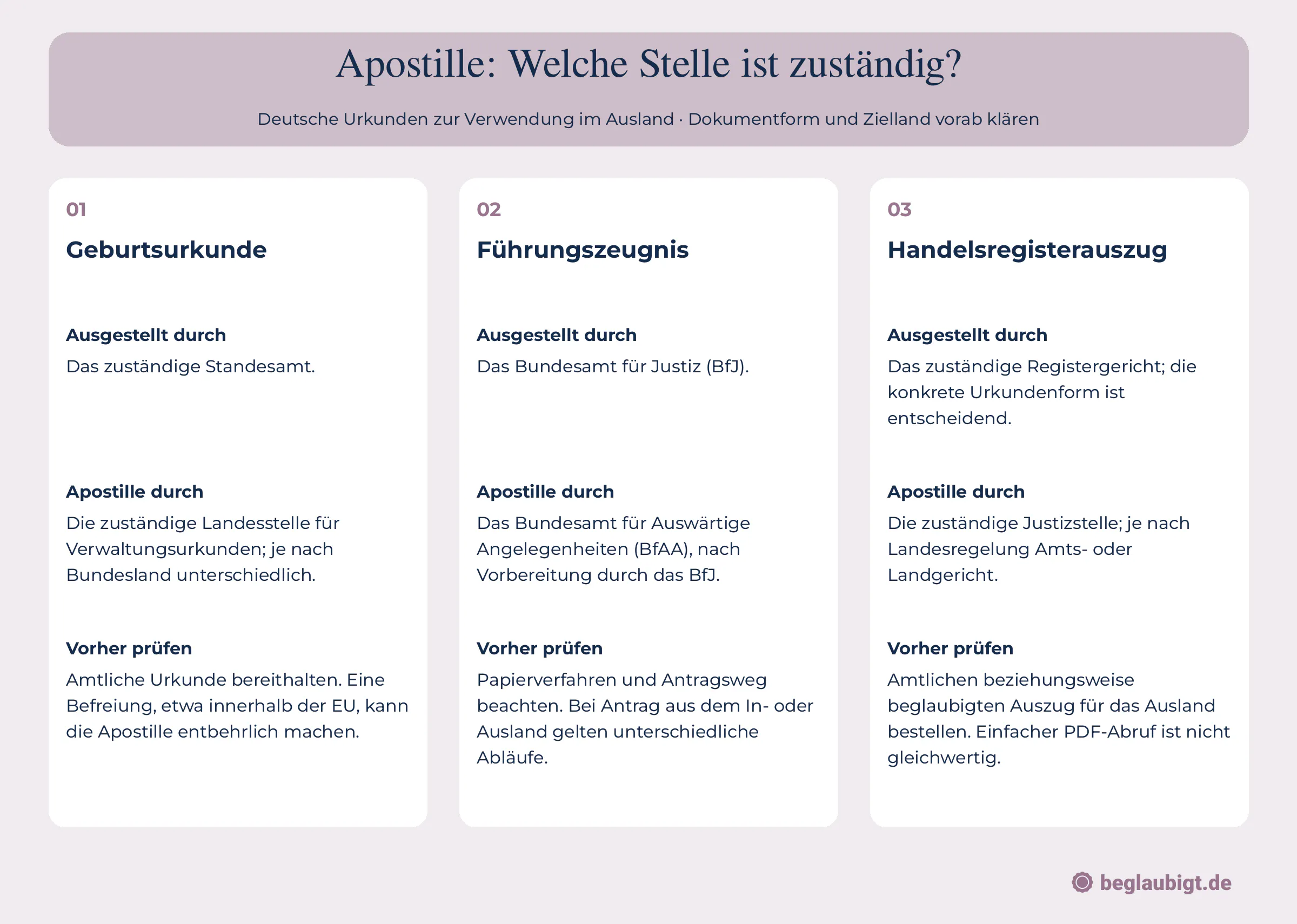
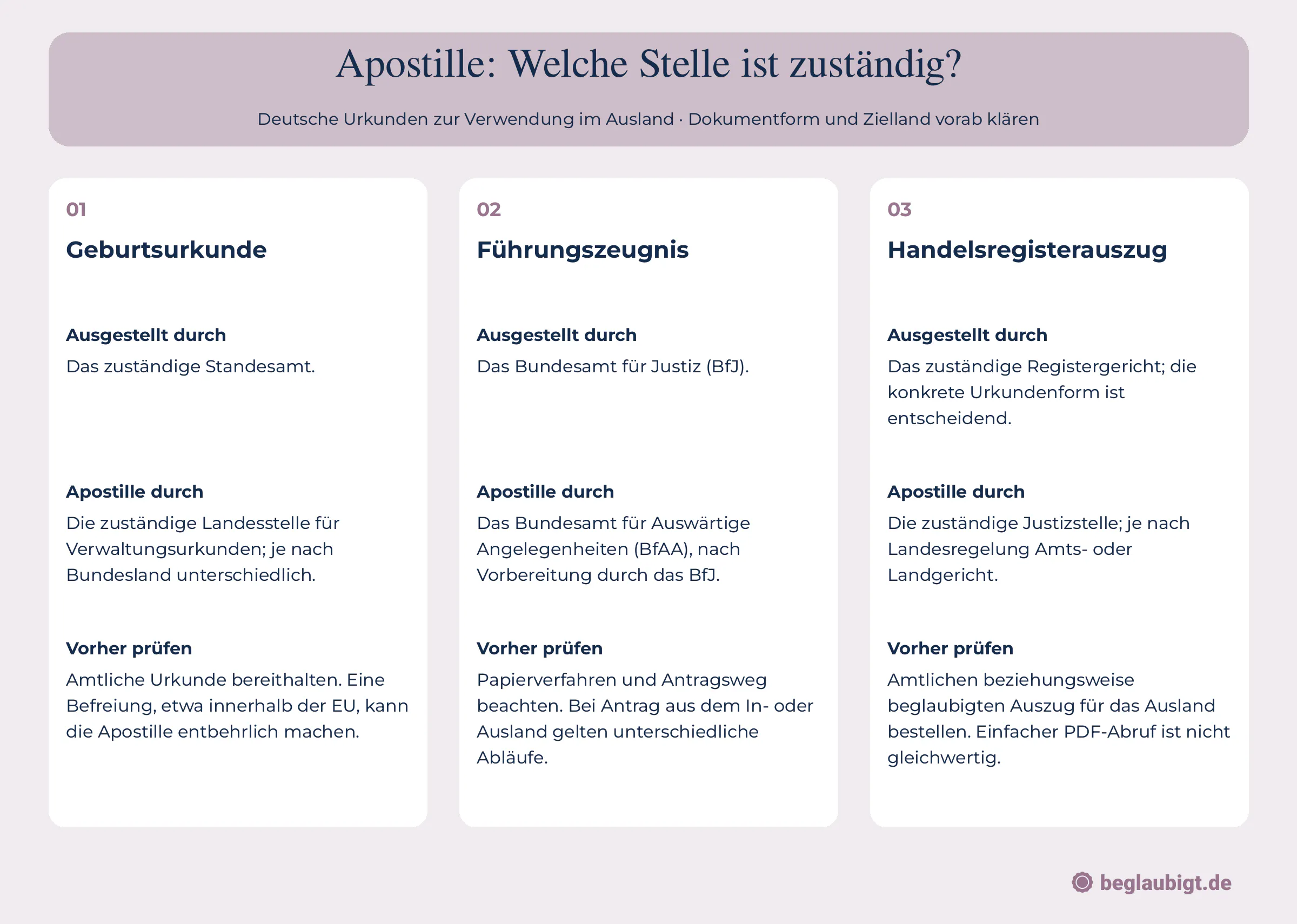
For the three common cases, the basic distinction is as follows: birth certificates are civil-status and administrative documents; certificates of conduct are issued by the Federal Office of Justice; and Commercial Register extracts come from the judicial system. The rules on responsibility vary between federal states. Particularly for judicial documents, it would therefore be incorrect to name the same court in every case. [1]
Apostille for a birth certificate: Where do you apply?
A German birth certificate is generally issued by the registry office that holds the relevant birth register. The apostille is then handled by the authority responsible for administrative documents under the law of the federal state concerned. Depending on the state, this may be a district government, a regional government or another designated state authority. In Berlin, the State Office for Citizens’ and Regulatory Affairs, known as LABO, handles the Berlin administrative documents covered by its service. [1] [4]
Moving to another federal state does not change which authority is responsible for the existing document. Also clarify whether you need a newly issued birth certificate or a particular register extract. Do not submit a privately made copy instead of the official document without checking. The Berlin authority, for example, requires the original.
Our article on having a birth certificate certified explains which documents you can obtain from the registry office and why a newly issued certificate is different from a certified copy.
Apostille for a certificate of conduct: Why are two federal agencies involved?
The certificate of conduct, or Führungszeugnis, is issued by the Federal Office of Justice, known as the BfJ. The apostille is issued by the Federal Agency for Foreign Affairs, known as the BfAA. The BfJ prepares the certificate for this purpose by adding a signature and seal. These are separate steps. Ordering a certificate of conduct and stating that it is intended for use abroad does not automatically replace the subsequent apostille application.
The procedures described below concern paper documents; the BfJ expressly excludes the Digital Certificate of Conduct from these instructions. [6] [7]
If you apply from within Germany, request the certificate of conduct and state that you need an apostille, specifying the destination country. After the BfJ has prepared it, the document is returned to you. You then apply and pay for the apostille through the BfAA and send the prepared original to that agency. For applications from abroad, the BfJ describes a different procedure: the BfAA application and the arrangements for matching it to the certificate must be organised in advance. The BfJ can then forward the prepared certificate directly to the BfAA. Follow the current procedural instructions, particularly when applying online. [7]
Apostille for a Commercial Register extract: Which version do you need?
A register extract downloaded free of charge is not the same as an official or certified register printout. If the organisation abroad requires an extract with an apostille, ask the competent register court directly which version you need. Provide the company name, register number, destination country and the type of extract required. Nuremberg Local Court expressly distinguishes between simple online printouts and certified extracts, and offers apostilles for register printouts. [9]
The apostille is issued by the judicial authority designated under the relevant state rules. This may be a local court or a regional court. You can therefore start by contacting the register court and asking it to confirm the required procedure. A notarial certificate or a certified copy is a separate document format; check in advance whether it meets the receiving organisation’s requirements. You can find more information about current, chronological and certified extracts in our guide to obtaining an official Commercial Register extract.
3. Applying for an apostille: The practical process
Which documents and details do you need?
A complete application starts with the appropriate document and the information required by the competent authority. Typically, this includes the document type, issuing body, destination country and return address. Also check the application form, payment method and any rules for submission by a third party. Depending on the procedure, further evidence or prior preparation of the document may be necessary. There is no universal form for all German apostille authorities.
Before posting anything, confirm that the document can be processed in its current form. A simple copy, a missing official endorsement or a signature that cannot be verified may lead to queries. For a Commercial Register extract, the appropriate official format is crucial; for a certificate of conduct, preparation by the BfJ is required. When using the apostille service from beglaubigt.de, therefore, provide the document, issuing body and destination country together. Digital preparation does not replace the document format required by the authority.
How do you apply for an apostille step by step?
1. Clarify the receiving organisation’s requirements. Ask about the document type, how recently it must have been issued, whether an apostille or exemption applies, and whether a translation is needed. This helps you avoid obtaining a document that is formally correct but unsuitable for its intended purpose.
2. Identify the issuer and competent authority. Establish whether your document comes from a federal authority, a registry office or a court. Then check which authority has responsibility for that document and issuing location.
3. Obtain the appropriate document format. If necessary, order a new civil-status certificate, a prepared certificate of conduct or an official register extract. An arbitrary printout is not automatically sufficient.
4. Complete the application and payment as instructed. Follow the competent authority’s current procedure. Some applications are submitted by post; others begin online. The BfAA’s published procedure includes entering the application details online and paying the fee.
5. Submit the documents and organise their return. Check original-document requirements, delivery arrangements and the return address. According to the BfAA’s published procedure, documents are returned within Germany, so establish a suitable receiving address early. [6]
6. Prepare the complete document for submission. Check whether a translation is also required and whether it must include the apostille. The document and its attached apostille should remain together.
Can you apply for an apostille entirely online?
An online application does not automatically mean an entirely digital process. At the BfAA, application details are entered online and fees are paid electronically. The application form sent to you must then be printed and submitted by post with the required documents, unless a specific forwarding arrangement applies. A scan may help with preparation, but it does not replace the document that must be submitted in a paper-based procedure. [6]
This differs from a genuine electronic apostille issued electronically by a competent authority. The Hague Conference describes these as part of its electronic Apostille Programme. Check with the responsible authority whether such a procedure is available for your document. Scanning a paper apostille into a PDF does not turn it into an electronically issued apostille. [2]
4. How long does it take to obtain an apostille?
What processing times do the authorities publish?
There is no standard processing time across Germany. Berlin’s LABO states approximately two weeks for postal processing within Germany and immediate completion for in-person applications; appointment availability and the applicable requirements must be considered separately. The Government of Middle Franconia, by contrast, asks applicants to allow three weeks for processing plus at least one additional week for postal delivery. These figures apply to the documents handled by the respective authorities and cannot be treated as promises for other authorities. [4] [5]
Published times also vary between judicial authorities. Augsburg Local Court generally lists two to three working days, while Hanover Regional Court currently lists three to four weeks. These examples show why a blanket statement such as “An apostille takes three days” is unreliable. Your planning should account for the authority actually responsible, its receipt of complete documents and the entire process through to submission abroad. [10] [11]
Why can the overall process take considerably longer?
The apostille authority’s processing time is only one part of the overall timeframe. Beforehand, you may need to order a new certificate, obtain a register extract or have a certificate of conduct prepared. Afterwards, return delivery, translation and delivery to the receiving organisation may follow. If documents are sent to the wrong authority or a preparatory step is missing, the relevant processing may not begin until the issue has been corrected.
For a certificate of conduct, take particular account of the multiple stages involved. The BfJ currently warns of longer processing times for applications from abroad and certificates with an international element, including preparation for an apostille or final authentication. No uniform overall timeframe is therefore promised here. [8]
Is there an express apostille service with a guaranteed completion date?
Whether expedited processing is possible depends on the competent authority’s procedures and capacity. A private service can prepare applications, identify the appropriate authority and organise delivery. However, it cannot generally guarantee an authority’s processing time. Distinguish between a quickly reviewed order, express delivery and the actual issuance of the apostille.
If you have a fixed appointment abroad, mention it before submission and ask about the earliest realistic completion date. Allow a buffer for queries and transport. Timing becomes particularly tight if the underlying document must also be obtained afresh. A complete, properly prepared submission is often more important than quickly posting documents to an authority whose responsibility has not yet been established.
5. Fees, translation and common mistakes
How much does an apostille application cost?
The fee depends on the procedure concerned. Berlin’s LABO lists €19 per certificate or document for its apostille service. Item 1310 of the fee schedule to the JVKostG provides for €25 for authenticating official signatures for use abroad; the relevant judicial authorities list this amount for apostilles. These fees should not be confused with a fixed total price for every German document. [4] [12]
Additional costs may arise for issuing the underlying document, delivery, translation and any private services you commission. For a certificate of conduct, distinguish between issuing the certificate and the subsequent apostille process. Do not assume that fees for another form of authentication also apply to an apostille. Our guide to apostille costs in 2026 explains the different cost components in more detail.
Should you obtain the apostille or the translation first?
The order should follow the receiving organisation’s requirements. Frequently, the document is apostilled first and the complete document, including the apostille, is then translated. In other cases, specific requirements apply to the translation or authentication of the translator’s signature. An apostille on the underlying document and authentication relating to a translation are different procedures.
Before commissioning a translation, therefore, clarify the required language, type of translation and scope of the documents to be translated. A multilingual document does not replace all further requirements in every situation, although it may simplify them depending on the legal basis. Avoid ordering a translation before establishing whether an apostille must be attached and translated as well. This can help prevent later additions and repeated postal journeys.
Which mistakes most often delay an application?
A common mistake is choosing the authority based on your own place of residence rather than the document and its issuer. Other problems include failing to specify the destination country, submitting an unsuitable copy or using a simple register download when an official document is required. For a certificate of conduct, the BfJ’s preparatory step may also be overlooked. Resolve these points before submission, rather than after the documents have been returned.
Another mistake is assuming that an apostille makes a document fully suitable for every intended use. The receiving organisation may require a specific document type, a recently issued version or a translation. Conversely, an exemption may make the apostille unnecessary. Check the purpose first and then establish how to obtain the required document. Having the right document without unnecessary additional steps is more useful than quickly obtaining an apostille for a document that does not meet the requirements.
- Your next step and further guides
How should you prepare your apostille application?
Gather the document type, issuing body and destination country, together with the receiving organisation’s requirements. Then check whether you already have a suitable document or need a newly issued certificate or official extract. Only then can you reliably determine the appropriate procedure. If you have a fixed deadline, plan document procurement, processing, translation and delivery as separate stages.
For German birth certificates, certificates of conduct and Commercial Register extracts, this process leads to different authorities. Understanding that distinction helps prevent a supposedly universal apostille application from being sent to the wrong place. For foreign documents, the assessment generally starts in the country of issue. A German apostille authority does not become responsible simply because the document will later be used in Germany or by someone living there. [2]
Further guides to apostilles
- Apostille costs in 2026: Fees and additional expenses
- Apostille or legalisation: Guidance by destination country
- When do you need an apostille?
- Having a birth certificate certified: Document formats and competent authorities
- Obtaining an official Commercial Register extract—including certified or translated versions
Next step with beglaubigt.de: Prepare the apostille for your document
Would you like support organising an apostille? Send beglaubigt.de the document type, issuing body, destination country and any deadline for submission. This allows the appropriate procedure to be coordinated for your circumstances. The apostille is issued by the competent public authority; using the service does not provide a general guarantee of official processing times.
Costs: These depend on the document, competent authority and agreed services. Before placing your order, ask for private service charges, public authority fees and delivery costs to be explained separately.
Get support preparing an apostille for your document
FAQ about applying for an apostille
Where do I apply for an apostille for my birth certificate?
Apply to the state authority responsible for administrative documents issued in the relevant area. The specific authority depends on the federal state. If in doubt, ask the registry office that issued the certificate. First check whether an apostille is actually required for your destination country and intended use.
Is the registry office itself the apostille authority?
The registry office issues the civil-status document. The apostille is generally obtained afterwards from a separately designated state authority. Some steps may be coordinated organisationally; follow the instructions of the registry office and competent apostille authority.
Who issues an apostille for a certificate of conduct?
The BfAA issues the apostille. The BfJ issues the certificate of conduct and prepares it for this purpose. For the paper-based procedures described here, note the different application routes from within Germany and from abroad. [7]
Can I obtain an apostille for a free Commercial Register download?
A simple download is not equivalent to the required official or certified document. Order the appropriate version from the register court, specifying the destination country and the need for an apostille. [9]
Do I have to apply for the apostille where I live?
Not automatically. The document type, issuing body and applicable rules on responsibility are decisive. Moving home does not, by itself, authorise the authority at your new address to apostille an existing document from another area of responsibility.
How long does it take to obtain an apostille?
That depends on the competent authority. Published examples range from a few working days to several weeks. Obtaining the document, preparatory steps, translation and delivery may add further time. There is no uniform overall timeframe across Germany.
Can I obtain an apostille without the original?
You must submit the appropriate document format for the procedure concerned. A scan is generally not a substitute in a paper-based procedure. Genuine electronic documents and electronic apostille procedures are subject to their own technical and legal requirements.
Do I need an apostille for every EU country?
Certain public documents covered by Regulation (EU) 2016/1191 are exempt when presented to authorities in other EU Member States. This exemption does not apply to all documents or simply because there is an EU connection. [3]
Does an apostille replace a certified translation?
No. Authentication and translation serve different purposes. Ask the receiving organisation whether a translation is required and whether it must cover the entire document, including the apostille.
How recently must the document have been issued?
That depends on the requirements of the specific procedure. An apostille does not automatically turn an older document into up-to-date evidence. Before ordering, clarify how old a certificate of conduct or register extract may be when it is presented.
Sources
[1] German Federal Foreign Office — International use of public documents and apostille authorities
[3] European e-Justice Portal — Public documents and Regulation (EU) 2016/1191
[4] Service Berlin — Apostilles: LABO document requirements, fees and processing times
[7] Federal Office of Justice — Certificates of conduct: Apostilles and use abroad
[9] Nuremberg Local Court — Register extracts and apostilles
[10] Augsburg Local Court — Responsibility, documents, processing time and fees
[11] Hanover Regional Court — Apostilles and current processing times
[13] beglaubigt.de — Apostille service and the provider’s role