You do not have to move to Germany to establish a German GmbH. Founders living abroad can generally own a German limited liability company and take part in its formation. The practical questions are how you will complete the notarial formalities, arrange a German business address and open a suitable company account. [1]
The route depends on your documents and role in the company. A shareholder who qualifies for online identification may be able to attend the notarial appointment by video. Another may need a properly authenticated power of attorney. If you will also be the managing director, your own registration declarations need to be arranged separately. This guide explains the requirements, the steps to prepare and how beglaubigt.de can help coordinate the process.
Key takeaways in 30 seconds
- Yes, you can establish a GmbH from abroad. German residence is generally not required for shareholders or managing directors. [1][2]
- The company needs a German presence for registration. Its statutory registered office must be in Germany, and the application must include a domestic business address. [3][4]
- A GmbH requires at least €25,000 in share capital. For an incorporation funded entirely in cash, at least one quarter of each share and at least €12,500 in total must be paid before the registration application. [5][6]
- Online formation depends on eligibility. Having a passport alone does not automatically enable you to use Germany’s notarial video procedure. Check the accepted electronic identification documents first. [7]
- A shareholder can use a representative. Under § 2(2) GmbHG, the formation power of attorney must be notarised or have the signature certified by a notary. The director’s declarations are a separate matter. [8][4]
- Company ownership and immigration permission are different. Incorporating a GmbH does not itself grant the right to live or work in Germany. [9]
- beglaubigt.de can help organise the formation. Its service includes document preparation and notarial appointment coordination, with remote representation available for suitable cases. [10]
Can I open a GmbH in Germany from abroad?
Yes. Living outside Germany does not generally prevent you from becoming a shareholder of a German GmbH. You can establish the company as an individual or through an existing foreign company. Germany Trade & Invest confirms that a GmbH can have an individual or legal entity as its shareholder and that shareholder nationality and residence are not the determining factors. [11]
For this guide, “non-resident” means a founder who lives outside Germany. It does not determine your personal tax residence, visa status or eligibility for electronic identification. Those questions require their own assessment.
Start by identifying your role. Will you only own shares, or will you also manage the business? Is the shareholder you personally, or a company you already own? The answers determine which identity documents, representation evidence and declarations need to be prepared.
You generally do not need a German shareholder simply because you live abroad. You do, however, need a workable arrangement for the company’s address, official correspondence and management. [1][2]
What does a non-resident need to set up a GmbH?
You need the usual GmbH formation requirements plus a clear plan for completing the formalities from your country of residence. Organise the address, identity checks and signing route before committing to an appointment.
Shareholders, a managing director and a clear company structure
A non-resident can generally be appointed as managing director. German residence or a permanent right of residence in the EU is not, by itself, a prerequisite for appointment. The director must nevertheless meet the statutory eligibility requirements and be able to fulfil the role. [2]
Decide who will manage the company, who may represent it and how shareholders approve important decisions. Ask your advisers to review the arrangements if management will take place outside Germany. Managing the business remotely involves ongoing responsibilities, not just a signature at incorporation.
Share capital and funds available for payment
The minimum share capital is €25,000 under § 5(1) GmbHG. For a formation funded entirely in cash, § 7(2) GmbHG requires payment of at least one quarter of the nominal amount of each share and at least €12,500 overall before registration is applied for. [5][6]
The unpaid balance remains an obligation. Paying €12,500 initially does not turn the company into a GmbH with only €12,500 of subscribed capital.
For example, if two founders each subscribe for a €12,500 share, each paying €6,250 would meet both payment thresholds. Confirm your actual allocation and payment instructions with the notary. Contributions in kind require a different assessment and additional documentation. [5][6]
Can I form the GmbH without travelling to Germany?
It may be possible, but the signing route must work for every required participant. Three practical routes are worth discussing with the German notary.
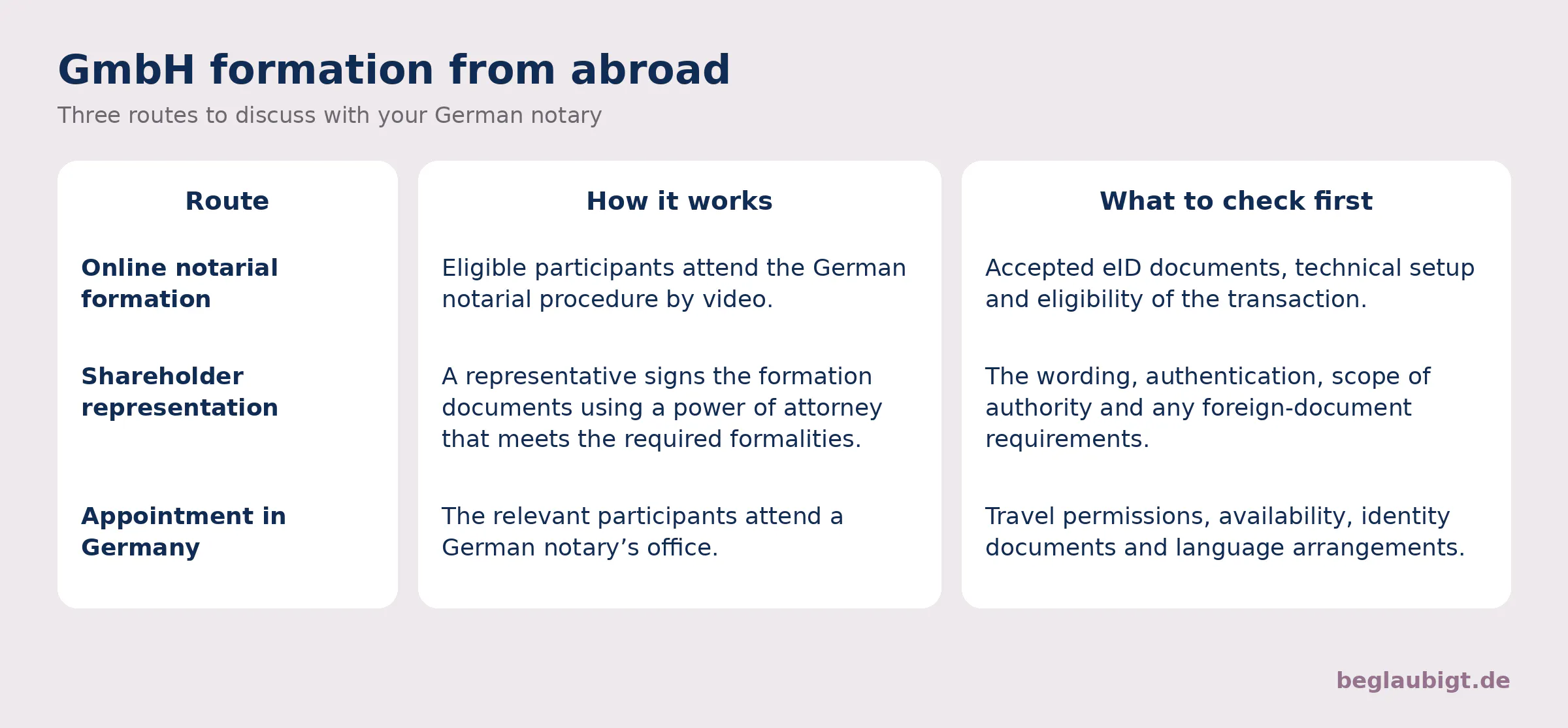
The legal basis for the notarial form, representation and video procedure is § 2 GmbHG. [8] Choose the route after the notary has reviewed the case, rather than assuming that every foreign founder can use the same procedure.
Online notarisation: check your eID before booking
Germany’s notarial video procedure uses electronic identification. The Federal Chamber of Notaries lists different requirements for German, EU and third-country nationals. Depending on your circumstances, a suitable eID document and an additional passport for the digital photograph may be needed. The technical setup includes an NFC-enabled smartphone with the Notary App and a device suitable for video calls. [7]
Send the notary the details of your identity documents early. Ask whether each participant qualifies and whether the proposed formation can use the video procedure. A successful bank video-identification check does not establish eligibility for notarial identification.
Our guide to online GmbH formation: requirements and process explains the digital procedure in more detail. The linked guide is in German.
Formation by power of attorney
A shareholder may authorise someone else to sign the articles of association. Under § 2(2) GmbHG, the power of attorney must be executed before a notary or have the signature certified by a notary. A simple emailed authorisation does not meet that requirement. [8]
Ask the German notary to approve the wording before you sign abroad. Confirm the named representative, the permitted actions and the required document format. This avoids paying for a document that later needs to be replaced.
Where foreign public documents are used in Germany, proof of authenticity may be required. Depending on the country, document and applicable arrangements, that can involve an apostille, legalisation or another verification procedure. [12]
The managing director’s declarations need separate planning
A shareholder’s formation power of attorney does not automatically cover everything required from the managing director. The registration application includes declarations about the capital and the director’s eligibility under § 8 GmbHG. [4]
If you are both shareholder and director, ask how your own declarations and signature will be completed. Discuss the permitted online procedure or an appropriately authenticated document signed abroad. A representative signing the articles for you does not remove the need to resolve this separate step.
IHK Frankfurt describes certification of a director’s registration signature abroad, including through a German mission or a foreign notary, with the document subsequently passed to the German notary. Confirm the available procedure and document requirements for your particular country before booking. [13]
Which documents should you prepare as a foreign founder?
Prepare an individual checklist with the German notary and bank. Requirements differ depending on whether the shareholder is a person or a foreign company and how the documents will be signed.
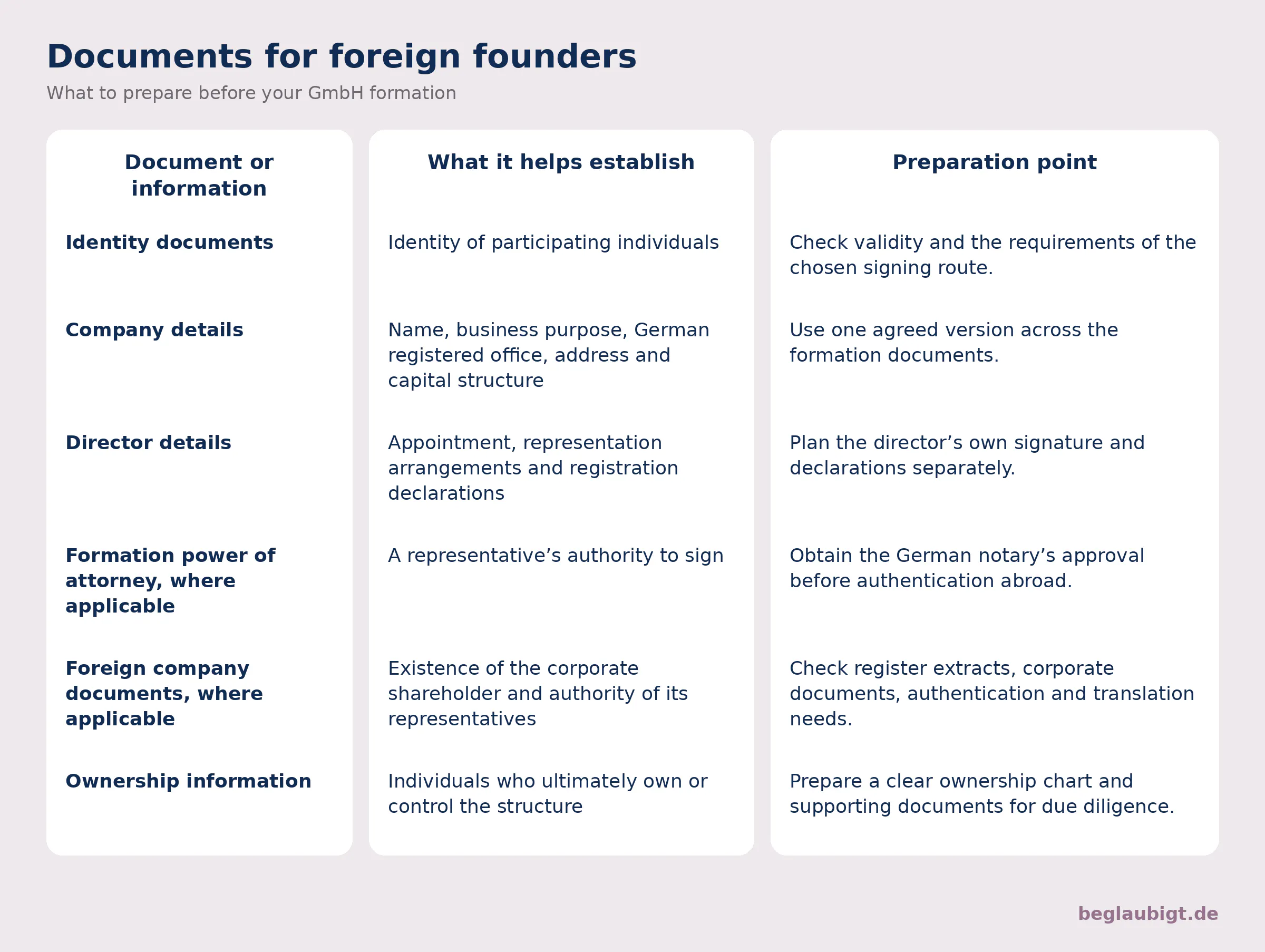
Germany Trade & Invest notes that a foreign corporate shareholder commonly needs documents showing its existence and the authority of the people acting for it. Authentication and translation requirements depend on the company’s origin and legal form. [11]
Do not order every possible certificate speculatively. Send the existing documents for review, obtain a precise checklist and then arrange the missing items. Confirm whether originals or particular certified copies are needed and whether there are requirements concerning document age.
Do I need translations or an interpreter?
Tell the notary early if you do not understand the language of the notarial document sufficiently. § 16 BeurkG sets out translation requirements and provides for an interpreter where the notary does not translate personally. Agree the language arrangements before the appointment. [14]
Foreign supporting documents may also require German translations. The Federal Foreign Office explains that authorities and courts may require translations prepared by a sworn or certified translator. An apostille authenticates a public document; it does not replace a translation or confirm that the document meets every German incorporation requirement. [12]
How do I open a company account and pay the capital from abroad?
Check the account-opening requirements before the notarial appointment. A bank’s ability to onboard your shareholder and management structure is a practical part of the formation plan.
Customer due diligence includes identifying the contracting party and beneficial owner and understanding the business relationship under § 10 GwG. [15] Ask the intended bank which documents and identification steps it requires for a company in formation with participants living abroad.
Useful questions include:
- Does the bank support the proposed shareholder and director structure?
- Which participants must complete identification, and by which method?
- What documents does it need for the company in formation?
- Can the account receive the proposed capital transfers?
- What evidence of payment can be supplied to the notary?
Once the account is ready, follow the agreed payment instructions and report completion to the notary. The managing directors must declare that the required contributions have been made and are at their free disposal. [4]
For a closer look at payment and documentation, see our guide to paying a GmbH’s share capital, available in German.
How does the formation process work with beglaubigt.de?
beglaubigt.de supports the preparation and coordination of GmbH formation. Its published process includes collecting company data, preparing documents and organising a notarial appointment online or in person. The service also describes remote formation with shareholder representation for suitable cases. [10]
For a founder abroad, the first discussion should resolve the signing route and outstanding documents. Be ready to provide your country of residence, nationality, shareholder structure, intended managing director and proposed German address. These details help identify which questions need to be settled before an appointment.
Step 1: Define the company and check the name
Agree the company name, business purpose, ownership and management arrangements. Check the intended name before finalising documents. Our IHK name-check guide, in German, explains the preliminary assessment. The final registration decision belongs to the register court.
Step 2: Agree the articles and signing route
Have the notary review whether standard formation documents suit the business or whether tailored articles are needed. Confirm online identification, any power of attorney and the director’s registration formalities. Put the document requirements and responsibilities in writing.
Step 3: Complete the notarial formalities
The independent notary carries out the notarisation. Attend through the agreed procedure or arrange valid shareholder representation. Make sure language requirements have been addressed and the agreed documents are available.
Step 4: Complete the capital payment requirements
Arrange the account, pay the required contributions and provide the agreed confirmation. The registration application must wait until the applicable capital requirements are satisfied. [6]
Step 5: Register and prepare the business launch
The notary submits the application electronically to the register court, which decides on entry. § 12 HGB governs the application’s form and electronic submission. [16] Our commercial register application guide, in German, provides further background.
The GmbH exists as such only once registered. Before entry, people acting in its name can face personal and joint liability under § 11 GmbHG. [17] Plan contracts and the business launch around the actual registration status.
How long does it take to establish a GmbH from abroad?
Plan for several weeks and build the schedule around your outstanding tasks. A German notary’s published overview gives roughly four to eight weeks as an indicative overall timeframe for GmbH formation up to registration. That is not a measured average for non-resident founders. [18]
Your timetable can be affected by foreign-document authentication, translations, account opening and arrangements for the director’s declarations. A short notarial appointment is only one stage in the process.
Set separate milestones for document approval, notarisation, account opening, capital payment and submission of the complete application. If the launch date matters, ask which outstanding task is currently preventing the next stage. Avoid treating a booked appointment as a confirmed company registration date.
What does a non-resident GmbH formation cost?
Budget for capital, formation services and ongoing administration separately. The subscribed share capital is funding for the company, rather than a service fee. Your cost estimate should separately identify notarial and register fees and any professional support you choose.
An overseas formation may also involve document authentication, translations, an interpreter, courier delivery or travel. Request a breakdown based on your actual route. Include the recurring costs of the German address, accounting and tax support in the business plan.
beglaubigt.de states that its service prices exclude external notary and register-court fees. Check the chosen package and any additional services before ordering. [10]
Do I need a German visa or residence permit?
Owning a GmbH does not itself give you permission to live or work in Germany. If you remain abroad, company formation and your immigration status are separate questions. If you intend to relocate or manage the company on-site, assess the permission required for that activity. [9]
Germany Trade & Invest explains that non-EU entrepreneurs managing a company in Germany may require a residence permit for self-employment. The appropriate route depends on the role and circumstances. [9]
Tell your immigration adviser whether you will be a shareholder, managing director or employee, where you will perform the work and whether you intend to move. Do not treat the commercial register entry as an immigration decision.
What tax and reporting obligations remain if I live abroad?
A foreign shareholder’s residence does not remove the company’s German obligations. Under § 1 KStG, a corporation with its registered seat or management in Germany falls within German unlimited corporate tax liability, subject to the applicable rules and treaty position. [19]
German company taxation generally includes corporate income tax, the solidarity surcharge and trade tax. Cross-border arrangements need an individual review, particularly when management takes place abroad or profits are distributed to a foreign shareholder. [20]
Ask advisers in the relevant countries to assess the actual location of management, any additional filing obligations and the treatment of director remuneration or dividends. These are planning questions; the presence of a German address alone does not settle them.
The company also needs tax registration. ELSTER provides a questionnaire specifically for newly established corporations. [21] Beneficial ownership information must be collected, kept current and reported to the Transparency Register under § 20 GwG. [22]
Assign responsibility for tax correspondence, accounting, filings and official mail before operations begin. Managing these tasks from abroad is easier when deadlines and responsibilities are explicit.
Checklist: prepare your GmbH formation from abroad
- Confirm who will hold shares and who will act as managing director.
- Agree the company name, business purpose and capital allocation.
- Arrange the German statutory registered office and business address.
- Have the notary confirm the online, representation or in-person route.
- Obtain approved wording before signing a power of attorney abroad.
- Agree authentication, translation and language requirements.
- Plan the director’s own declarations and signature.
- Check company-account onboarding before the appointment.
- Make the required capital available and follow the payment instructions.
- Prepare tax registration, beneficial ownership reporting and mail handling.
- Review immigration requirements if you intend to work in Germany.
- Set separate dates for notarisation, registration and the business launch.
Start your German company with a clear formation plan
You can generally establish a GmbH while living abroad. The key is to resolve the address, documents, signing procedure and account arrangements before they hold up the application. Plan your role as managing director separately from your role as shareholder.
Ready to discuss the route for your case? Start your GmbH formation with beglaubigt.de and clarify the next steps for your documents and company structure.
FAQ: setting up a GmbH as a non-resident
Can a non-EU citizen own a German GmbH?
Generally, yes. Shareholder nationality and residence do not generally prevent GmbH ownership. The formation requirements still apply, and working or living in Germany is a separate immigration question. [1][9]
Can I be the sole shareholder while living abroad?
Yes, a GmbH can have one shareholder. Prepare the company address, capital, signing route and management arrangements in the same way as for a company with several founders. [11]
Does the managing director have to live in Germany?
German residence is not generally required for appointment. The director must meet the statutory requirements and be able to carry out the role. Assess immigration and cross-border tax questions where relevant. [2]
Can I incorporate using only my passport and a video call?
Do not assume so. The German notarial online procedure requires suitable electronic identification and may also require a passport. Ask the notary to check your documents before relying on this route. [7]
Can someone sign the formation documents for me?
Yes, a shareholder can use a representative with a power of attorney meeting § 2(2) GmbHG. The managing director’s required declarations and signing arrangements must be addressed separately. [8][4]
Can my foreign company be the shareholder?
Yes, a legal entity can hold the shares. The German notary will need appropriate evidence of the foreign company’s existence and the authority of the people acting for it. [11]
Is €12,500 the minimum share capital?
No. The minimum subscribed share capital is €25,000. For a cash-only formation, the payment required before applying for registration is at least one quarter of each share and at least €12,500 overall. The remaining contribution obligation continues. [5][6]
Does forming a GmbH give me a German residence permit?
No. Formation and immigration permission are separate. If you intend to work or live in Germany, check the requirements for your intended role and activity. [9]
Can beglaubigt.de help me form the company from abroad?
Its published offering includes remote formation and representation in suitable cases. Confirm the available route, documents and package for your situation before booking. [10]
References
[1] Federal economic ministry’s start-up portal: forming a GmbH while living abroad
[2] IHK Berlin: GmbH and UG, including non-resident managing directors
[3] § 4a GmbHG: statutory registered office
[4] § 8 GmbHG: contents of the registration application and declarations
[6] § 7 GmbHG: prerequisites for registration
[7] Federal Chamber of Notaries: technical and identity-document requirements
[8] § 2 GmbHG: notarial form, representation and online procedure
[9] Germany Trade & Invest: residence permits for self-employed business owners
[10] beglaubigt.de: GmbH formation services
[11] Germany Trade & Invest: setting up a GmbH
[12] Federal Foreign Office: foreign public documents for use in Germany
[13] IHK Frankfurt: appointment and registration of foreign managing directors
[14] § 16 BeurkG: language and translation in notarisation
[15] § 10 GwG: customer due diligence
[16] § 12 HGB: electronic commercial register applications
[17] § 11 GmbHG: legal status before registration
[18] Notariat Franke: indicative formation timelines
[19] § 1 KStG: corporate tax liability
[20] Germany Trade & Invest: corporate taxation in Germany
[21] ELSTER: tax registration questionnaire for corporations