A business’s legal structure determines more than liability and capital requirements: it also has a significant impact on tax obligations. Whether you operate as a sole proprietorship, GmbH, or UG, each structure brings different requirements for income tax, corporate income tax, trade tax, and VAT. Understanding these tax differences early on helps you plan effectively, make use of allowances, and optimize your tax burden over the long term.
This article explains in practical terms how your choice of legal structure shapes your tax strategy, which taxes and obligations you will face, and how conversions between sole proprietorships and corporations can be structured for tax purposes. Using specific examples, Federal Fiscal Court (BFH) rulings, and guidance on international taxation, it shows how business owners can plan their taxes effectively. For further information on the tax obligations associated with each legal structure, beglaubigt.de provides a reliable overview.
- Tax fundamentals and the legal framework
How does my business’s legal structure (GmbH, UG, sole proprietorship) affect my tax obligations under the EStG and KStG?
A business’s legal structure largely determines who is treated as the taxpayer and which taxes apply.
In a sole proprietorship, the owner is directly liable for tax. This means that the business’s profit is attributed to the owner’s income and is subject to income tax under § 2 of the German Income Tax Act (EStG).
- Profits are reported in the owner’s personal income tax return.
- The solidarity surcharge and, where applicable, church tax are charged in addition to income tax.
By contrast, GmbHs and UGs are legal entities that are themselves taxpayers under the German Corporate Income Tax Act (KStG). Under Section § 1 KStG, these companies’ taxable income is subject to corporate income tax, currently at a rate of 15%.
- A solidarity surcharge of 5.5% is levied on corporate income tax, bringing the effective tax rate to approximately 15.83%.
- Profit distributions to shareholders are subsequently subject to a final withholding tax, which can result in two layers of taxation.
The choice of legal structure therefore affects not only the amount of tax payable, but also the type of tax return and the responsibilities toward the tax office.
Example:
- A sole proprietor with a profit of €50,000 pays income tax on the full amount in accordance with the income tax schedule.
- A GmbH with the same profit initially pays corporate income tax at 15.83%, before distributions to shareholders are taxed.
For practical guidance on starting a business and choosing a legal structure, consult the article on beglaubigt.de, which clearly sets out the tax obligations associated with each structure.
The distinction between liability for income tax (§ 2 EStG) and liability for corporate income tax (§ 1 KStG) remains essential for identifying tax risks and opportunities for optimization at an early stage.
- Sole proprietorship → The owner is the taxpayer
- GmbH/UG → The company is the taxpayer
This distinction has a significant impact on tax planning, the amount of tax payable, and the bookkeeping required.
How does my business’s legal structure (GmbH, UG, sole proprietorship) affect my trade tax obligations?
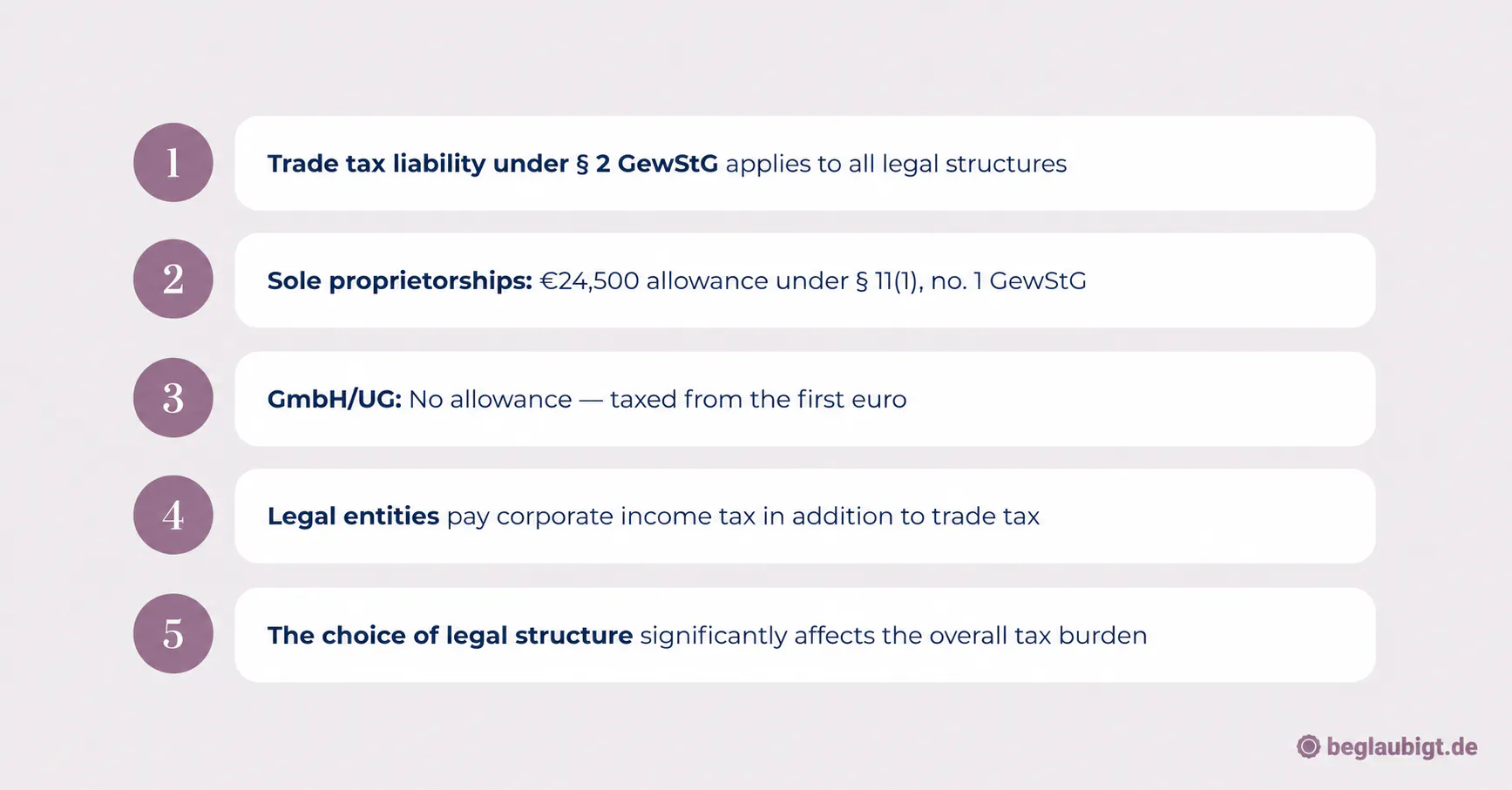
Liability for trade tax under § 2 of the German Trade Tax Act (GewStG) extends to all businesses carrying on a trade, regardless of their legal structure.
Sole proprietorships benefit from a €24,500 allowance under § 11(1), no. 1 GewStG, which reduces taxable profit and eases the burden on smaller businesses.
- Profits below the allowance are exempt from trade tax.
- Above this threshold, profit is multiplied by the trade tax multiplier set by the relevant municipality.
GmbHs and UGs do not receive this allowance. All profits are subject to trade tax, regardless of their amount.
- This results in a relatively higher tax burden, particularly on smaller profits, compared with sole proprietorships.
- For legal entities, trade tax is a separate tax, payable in addition to corporate income tax under § 1 KStG.
Corporations with their registered office or place of management in Germany are subject to unlimited corporate income tax liability, meaning that all domestic income earned by legal entities is taxable.
Example:
- A sole proprietor with a profit of €30,000 benefits from an allowance of €24,500, leaving only €5,500 subject to trade tax.
- A GmbH with the same profit must pay tax on the full €30,000.
The choice of legal structure therefore affects the amount of trade tax payable, the options for crediting it against income tax (for example, for sole proprietorships), and the complexity of tax planning.
For further information on choosing a legal structure and the associated tax obligations, consult the overview on beglaubigt.de.
How does my business’s legal structure (GmbH, UG, sole proprietorship) affect my VAT obligations?
Under § 1 of the German VAT Act (UStG), VAT law applies uniformly to all businesses, regardless of their legal structure.
- Both sole proprietorships and GmbHs and UGs must charge VAT on their taxable supplies of goods and services and remit it to the tax office.
- VAT is calculated at the applicable rates of 7% or 19%.
Differences arise from the small business VAT scheme under § 19 UStG, which is relevant exclusively to sole proprietors.
- Sole proprietorships whose revenue did not exceed €22,000 in the previous calendar year and is not expected to exceed €50,000 in the current year may be exempt from VAT.
- This exempts them from filing advance VAT returns and showing VAT on invoices.
By contrast, GmbHs and UGs are generally required to file advance VAT returns, with the frequency depending on their revenue:
- Annual revenue of up to €1,000 → No advance return
- Annual revenue of up to €100,000 → Quarterly advance returns
- Annual revenue of more than €100,000 → Monthly advance returns
The legal structure therefore does not affect the basic obligation to pay VAT, but practical exemptions and administrative obligations, such as advance returns and accounting requirements, vary.
For specific guidance on starting a business and the VAT treatment of individual legal structures, consult the overview on beglaubigt.de.
- Sole proprietorships and tax obligations
How does operating as a sole proprietorship affect my income tax obligations?
In a sole proprietorship, profits are reported directly in the owner’s income tax return, as set out in § 15 EStG.
- This means that business profit becomes part of the owner’s taxable income.
- Income from trade, self-employment, or agriculture and forestry is considered together.
Income tax follows a progressive tax schedule under § 32a EStG, with rates increasing gradually as taxable income rises.
- Lower profits are taxed at lower rates, while higher income leads to higher tax rates.
- This can cause the tax burden to rise significantly as the business becomes more successful.
Sole proprietors can calculate profit using the cash-basis method (Einnahmen-Überschuss-Rechnung) under § 4(3) EStG.
- This simplified method compares business receipts with business expenses without requiring double-entry bookkeeping.
- It reduces administrative work and makes the annual tax return easier to prepare.
Example:
- A sole proprietor earns an annual profit of €60,000. This is reported together with other income in the income tax return and taxed under the progressive schedule in § 32a EStG.
For detailed information on the tax treatment of sole proprietorships, consult the overview on beglaubigt.de.
How does operating as a sole proprietorship affect my obligations regarding social security contributions?
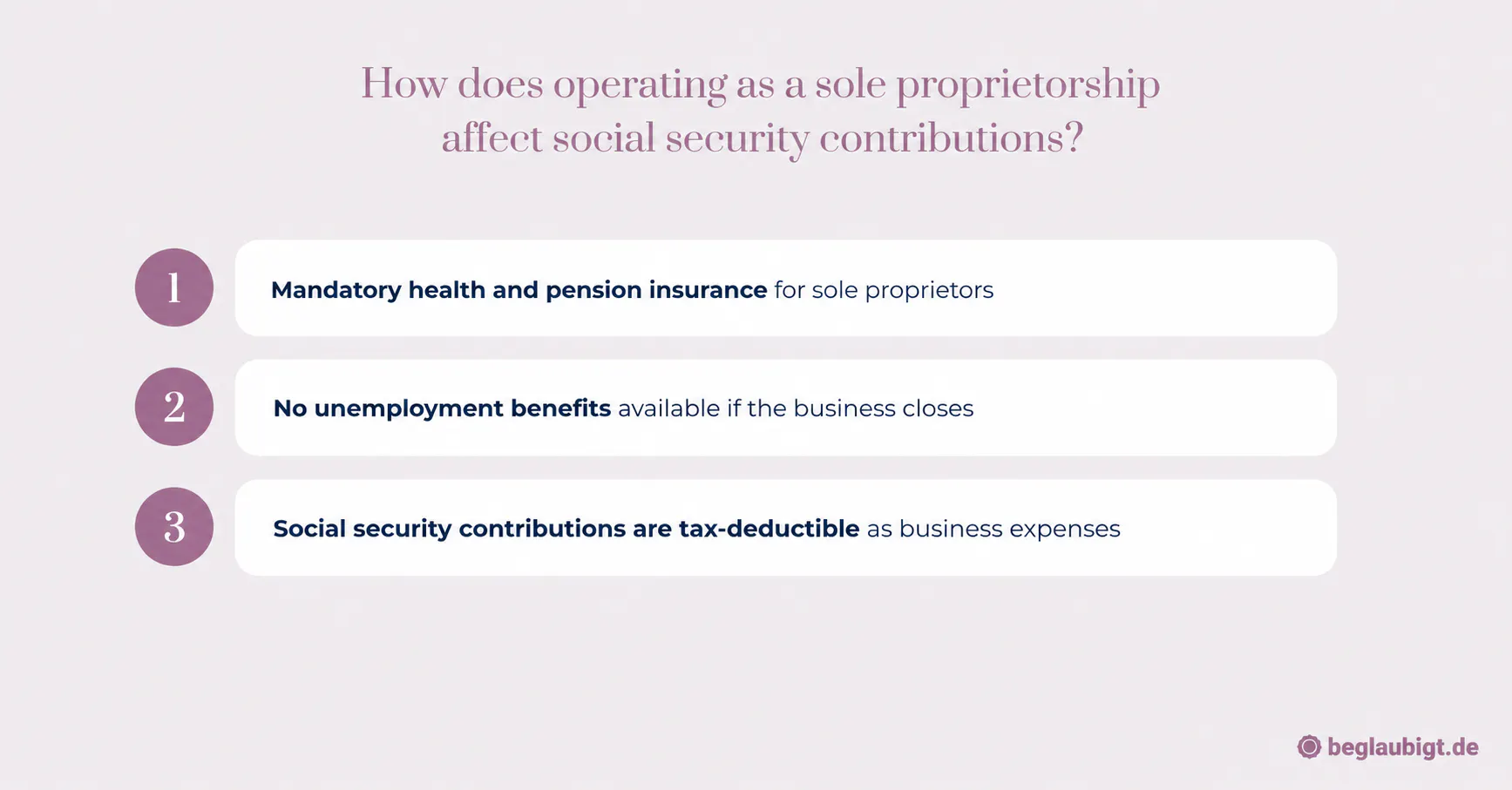
A sole proprietor is required to pay contributions toward health and pension insurance.
- Depending on the owner’s status, these contributions may be mandatory or voluntary, for example through voluntary membership in the statutory pension insurance scheme under Book VI of the German Social Code (SGB VI) or health insurance under Book V (SGB V).
- The amount of the contributions depends on income and can significantly affect the business’s liquidity.
If the business fails, there is no entitlement to unemployment benefits, as sole proprietors do not pay into unemployment insurance.
- This means that the owner bears the full personal risk.
- Alternatively, the owner can arrange protection, such as voluntary unemployment insurance, or build up reserves.
Social security contributions therefore directly affect the tax burden and liquidity: the contributions may be deductible as business expenses before tax, but they also tie up funds.
Example:
- A sole proprietor with a profit of €50,000 must pay health insurance contributions of approximately 14% of income, amounting to around €7,000, before income tax is calculated.
For specific guidance on social protection and the tax treatment of sole proprietorships, consult the overview on beglaubigt.de.
How does operating as a sole proprietorship affect my tax obligations when making investments?
A sole proprietor who opts for the small business VAT scheme under § 19 UStG cannot claim an input VAT deduction.
- This means that VAT on investments is not refunded, and the owner bears the full acquisition cost.
- Investments therefore have a greater impact on liquidity because no VAT is refunded.
At the same time, sole proprietors can benefit from depreciation under § 7 EStG.
- The acquisition costs of movable assets or buildings can be deducted for tax purposes over their useful life.
- This reduces taxable profit and lowers the income tax burden.
Another risk is personal liability for tax debts.
- If payments are late or incomplete, the owner is liable with all of their personal assets.
- This makes careful liquidity planning and the creation of reserves essential.
Example:
- A sole proprietor buys a machine for €20,000. Under the small business VAT scheme, the 19% VAT cannot be deducted, while depreciation over five years reduces profit and the tax burden.
- GmbH and tax obligations
How does operating as a GmbH affect my corporate income tax and trade tax obligations?
A GmbH is subject to corporate income tax at a fixed rate of 15%, as set out in § 23(1) KStG.
- A solidarity surcharge of 5.5% is levied on corporate income tax, increasing the effective rate to approximately 15.83%.
- Tax liability applies regardless of the amount of profit, as the GmbH, as a legal entity, is itself the taxpayer.
In addition, a GmbH pays trade tax, the amount of which depends on the multiplier set by the relevant municipality.
- Unlike sole proprietorships and partnerships, it does not receive the €24,500 allowance under § 11 GewStG.
- This results in a comparatively higher tax burden, particularly on smaller profits.
Example:
- A GmbH earns an annual profit of €50,000. This profit is initially subject to 15% corporate income tax plus the solidarity surcharge.
- Trade tax is then calculated on the full profit, with the multiplier varying by municipality.
Start your company formation with beglaubigt.de!
How does operating as a GmbH affect my tax obligations when distributing profits to shareholders?
In a GmbH, profits are initially subject to corporate income tax before they are distributed to shareholders.
- Distributed dividends are additionally subject to final withholding tax under § 43 EStG or, alternatively, the partial-income method under § 3, no. 40 EStG, which can result in two layers of taxation.
- The effective tax burden depends on the amount distributed and the chosen tax treatment.
There is a clear distinction between salary and profit distributions:
- Salaries paid to shareholder-managing directors are deducted as business expenses and are subject to wage tax, while distributions are paid out of profits that have already been taxed.
- A strategic allocation between salary and dividend distributions can influence the tax burden.
In addition, hidden profit distributions (verdeckte Gewinnausschüttungen, vGA) may have tax implications.
- Payments or remuneration to shareholders that do not meet the arm’s-length standard are treated by the tax office as hidden profit distributions and increase the GmbH’s corporate income tax liability.
- This requires careful documentation and structuring to minimize tax risks.
Example:
- A GmbH earns a profit of €100,000 and distributes €50,000 to its shareholder. The company’s profit is subject to 15% corporate income tax plus the solidarity surcharge, with an additional 25% final withholding tax on the distribution if the partial-income method does not apply.
How does operating as a GmbH affect my tax obligations when incurring losses?
A GmbH can claim tax relief for losses by using loss carryforwards and loss carrybacks under § 10d EStG.
- Losses can be carried forward to future years to reduce the tax burden in years with high profits.
- Alternatively, losses can be offset against the previous year’s profits, which can provide immediate relief for liquidity.
Restrictions arise under § 8c KStG, the so-called shell acquisition rules, which limit the use of loss carryforwards when a majority stake in a corporation is acquired.
- A change in ownership involving more than 50% of the shares may mean that previous losses can no longer be used, either in part or in full.
- This is particularly relevant to business acquisitions or capital increases.
Compared with a sole proprietorship, a GmbH offers advantages when periods of losses can be anticipated:
- Losses do not directly affect the shareholder’s personal income.
- This facilitates strategic tax planning and investment decisions during growth or start-up phases.
Example:
- A GmbH incurs a loss of €30,000 in its first year. This loss can be carried forward and offset against future profits, reducing corporate income tax in subsequent years.
- If more than 50% of the shares are sold, § 8c KStG applies, and some of the losses could be forfeited.
- UG (haftungsbeschränkt) and tax obligations
How do my tax obligations as a UG compare with those of a GmbH?
A UG (haftungsbeschränkt) is subject to the same tax regime as a GmbH, including corporate income tax (KSt), trade tax (GewSt), and VAT (USt).
- A UG’s profits are initially subject to 15% corporate income tax, plus the solidarity surcharge.
- Trade tax is payable according to the municipality’s multiplier; no allowance is available under § 11 GewStG.
One difference is the requirement to build up reserves under § 5a of the German Limited Liability Companies Act (GmbHG), as a UG’s share capital may be below €25,000.
- Each year, part of the annual net profit must be allocated to statutory reserves until share capital reaches €25,000.
- These reserves reduce distributable profit and affect liquidity and the tax implications of the company’s distribution policy.
The low level of capitalization can have tax implications:
- Low equity increases the risk of liquidity shortages and may limit opportunities to offset losses or make investments.
- Tax burdens such as corporate income tax and trade tax fall on a small capital base, which can make the effective burden appear relatively higher.
Example:
- A UG with €1,000 in share capital earns a profit of €10,000. Part of the profit must be allocated to reserves before distributions are made to shareholders, while corporate income tax is payable on the full profit.
For detailed guidance on building up reserves and the tax features specific to a UG, consult the article on beglaubigt.de.
How does operating as a UG affect my tax obligations regarding distributions and reserves?
In a UG, profits are retained until the statutory minimum share capital of €25,000 is reached, in accordance with § 5a GmbHG.
- Part of the annual net profit must be allocated to statutory reserves each year.
- This leads to more profits being tied up than in a GmbH, as fewer funds are available for immediate distribution.
The tax burden on later distributions is generally the same as for a GmbH:
- Distributed profits are subject to final withholding tax under § 43 EStG or the partial-income method under § 3, no. 40 EStG.
- Retained profits increase the amount available for later distribution, which can increase the cumulative tax burden.
Compared with a GmbH, the difference is particularly evident in the long-term retention of profits:
- GmbHs have greater freedom to distribute profits, while UGs are required to build up reserves until their share capital has been increased.
- This affects both the company’s liquidity and its strategic financial planning.
Example:
- A UG earns a profit of €20,000 with €1,000 in share capital. At least 19% must be retained as reserves before distributions are made, limiting the amount available to shareholders.
For further information on retaining profits and building up reserves in a UG, consult the article on beglaubigt.de.
- Practical decision-making guidance and case law
How does my business’s legal structure (GmbH, UG, sole proprietorship) affect my tax obligations when doing business internationally?
In international business, double taxation agreements (DTAs) play a central role in avoiding double taxation.
- These agreements determine which country has the right to tax particular types of income, such as dividends, interest, or royalties.
- DTAs apply equally to sole proprietorships, GmbHs, and UGs, although their specific application depends on the type of income and the legal structure.
A company’s registered office and place of management are decisive for tax liability in Germany under § 10 of the German Fiscal Code (AO).
- Legal entities with their registered office or place of management in Germany are subject to unlimited corporate income tax liability, while sole proprietors resident in Germany are likewise subject to unlimited income tax liability.
- Changes to the registered office or place of management can affect tax liability and the application of DTA provisions.
There are also differences regarding withholding taxes on dividends:
- GmbHs and UGs distributing dividends abroad must take account of final withholding tax and, where applicable, arrange for withholding tax to be credited in the recipient country.
- Sole proprietors are subject to this rule only if they receive income from foreign sources.
Example:
- A German GmbH distributes dividends to a shareholder in France. DTA provisions limit withholding tax to 15%, which can be credited against German corporate income tax.
- A sole proprietor with foreign income can reduce the tax burden under a DTA through the provisions of the Income Tax Act.
For further guidance on the international taxation of corporations and sole proprietorships, consult the overview on beglaubigt.de.
How does case law address the effect of my business’s legal structure (GmbH, UG, sole proprietorship) on my tax obligations?
Case law from the Federal Fiscal Court (BFH) provides numerous precedents on the distinction between income tax and corporate income tax.
- Sole proprietorships are subject to income tax under § 2 EStG, while corporations such as GmbHs and UGs pay corporate income tax under § 1 KStG.
- BFH rulings clarify which income is considered business-related and which is attributable to the owner’s private affairs, helping to avoid double taxation.
Decisions on hidden profit distributions (vGA) have shaped the understanding of the tax treatment of shareholder transactions.
- Payments that do not meet the arm’s-length standard are treated as hidden profit distributions and increase the company’s corporate income tax liability.
- Examples from case law show that, particularly for GmbHs and UGs, unreasonable remuneration paid to shareholder-managing directors can be adjusted retrospectively.
Cases concerning trade tax allowances and their loss illustrate differences between legal structures.
- BFH decisions confirm that sole proprietorships and partnerships can use the €24,500 allowance under § 11 GewStG, while corporations cannot claim it.
- Court rulings show how incorrect assessments or structural changes affect the use of allowances and loss carryforwards.
Example:
- A GmbH received an additional trade tax assessment because the allowance does not apply to corporations, while a sole proprietor in a similar case was able to claim it.
For a detailed explanation of BFH case law on the tax obligations of different legal structures, consult the overview on beglaubigt.de.
How does my business’s legal structure (GmbH, UG, sole proprietorship) affect my tax obligations in long-term tax planning?
The choice of legal structure affects the options for tax optimization throughout the business’s lifetime.
- Sole proprietorships allow losses to be offset directly against personal income and benefit from allowances such as the trade tax allowance under § 11 GewStG.
- Corporations such as GmbHs and UGs offer the option of retaining profits: corporate income tax is payable, but distributions can be planned for tax purposes.
Flexibility comes from switching between a sole proprietorship and a corporation.
- A conversion can be tax-neutral under the German Reorganization Tax Act (UmwStG), provided certain conditions are met.
- This makes it possible, for example, to use the tax advantages of a GmbH or UG once the business grows or outside investors become involved.
Practical examples illustrate the effect:
- A sole proprietor with highly fluctuating profits can initially use the allowance and loss relief, then later convert to a GmbH to manage the tax burden through retained profits and planned distributions.
- Similarly, a UG can be used as a start-up company to begin tax-efficiently with low share capital and gradually transition into a fully capitalized GmbH.
For further guidance on long-term tax planning with different legal structures, consult the overview on beglaubigt.de.
Summary of the key points
The choice of legal structure has a decisive impact on tax obligations, the amount of tax payable, and the options available for running the business. Tax planning errors often arise from insufficient knowledge of different taxes, incomplete documentation, or missed deadlines. This article shows how businesses can minimize typical risks and optimize their tax burden over the long term through a clearly chosen legal structure, careful bookkeeping, and targeted tax measures.
Recommended actions at a glance:
- Distinguish correctly between income tax and corporate income tax – Sole proprietorships are subject to income tax (§ 2 EStG), while GmbHs and UGs are subject to corporate income tax (§ 1 KStG).
- Account for trade tax liability – Use available allowances (for example, § 11 GewStG for sole proprietorships) and take municipal multipliers into account.
- Apply VAT rules correctly – Check whether the small business VAT scheme (§ 19 UStG) applies to a sole proprietorship; submit corporations’ advance returns on time.
- Plan profit distributions strategically – Avoid double taxation arising from final withholding tax (§ 43 EStG) or the partial-income method (§ 3, no. 40 EStG).
- Use losses for tax purposes – Make use of loss carryforwards and carrybacks under § 10d EStG, observing the restrictions under § 8c KStG.
- Put documentation and deadline management in place – Meet bookkeeping requirements and consistently monitor tax-related deadlines.
- Use legal advice and official guidance – For international documents or complex conversions, certified documents obtained through beglaubigt.de may be required.
- These measures help reduce tax risks, maintain liquidity, and make the most of long-term planning opportunities.
How beglaubigt.de supports tax planning and the choice of legal structure
Structuring a business for tax purposes requires precise knowledge of legal structures, types of tax, and deadlines. Errors often occur when tax obligations are misclassified, international documents need to be considered, or tax filing deadlines are missed. beglaubigt.de offers practical support by enabling businesses to submit tax-related documents correctly, in certified form, and digitally.
The platform makes legally compliant processing easier, particularly where international interests are involved—for example, when shareholders are based abroad or contracts are in another language. It combines legal precision with modern digital processing, reducing the risk of incorrect tax returns or documents being rejected by tax authorities.
Key services offered by beglaubigt.de at a glance:
- Certified translations of articles of association, shareholder lists, or annual financial statements for international matters.
- Digital submission of tax documents and registrations in compliance with statutory requirements, including electronic formats.
- Deadline management through structured processes to avoid late or incomplete tax returns.
- Consideration of country-specific regulations, for example, in matters involving foreign investors or double taxation agreements.
- Legally compliant documentation of powers of attorney, minutes of resolutions, or proof of capital to minimize tax risks.
In this way, beglaubigt.de helps businesses meet their tax obligations efficiently, correctly, and in a form suitable for international use.