Starting a German company from abroad is possible, but “online company formation” does not mean every founder can complete every step remotely. Your identity documents, the country where documents are issued and whether you will also act as managing director all influence the process.
For some founders, incorporation can take place through an online appointment with a German notary. Others will need to attend in person or arrange for a representative to sign the incorporation documents under a power of attorney. Alongside the notarial procedure, you need a suitable German business address, a workable banking solution and a plan for the company’s tax registration.
This guide explains how those requirements fit together, where international founders commonly encounter delays and what to clarify before paying for translations, booking travel or signing documents abroad.
The Most Important Points in 30 Seconds
- Living abroad does not generally prevent you from forming a GmbH or UG. Shareholders and managing directors do not normally need a German residential address.
- The company itself needs a German registered seat and domestic business address. That address must work for official correspondence; acceptance by the register court does not automatically establish acceptance by a bank or tax office.
- Online notarisation requires an accepted eID. A biometric passport alone does not necessarily meet the identification requirements.
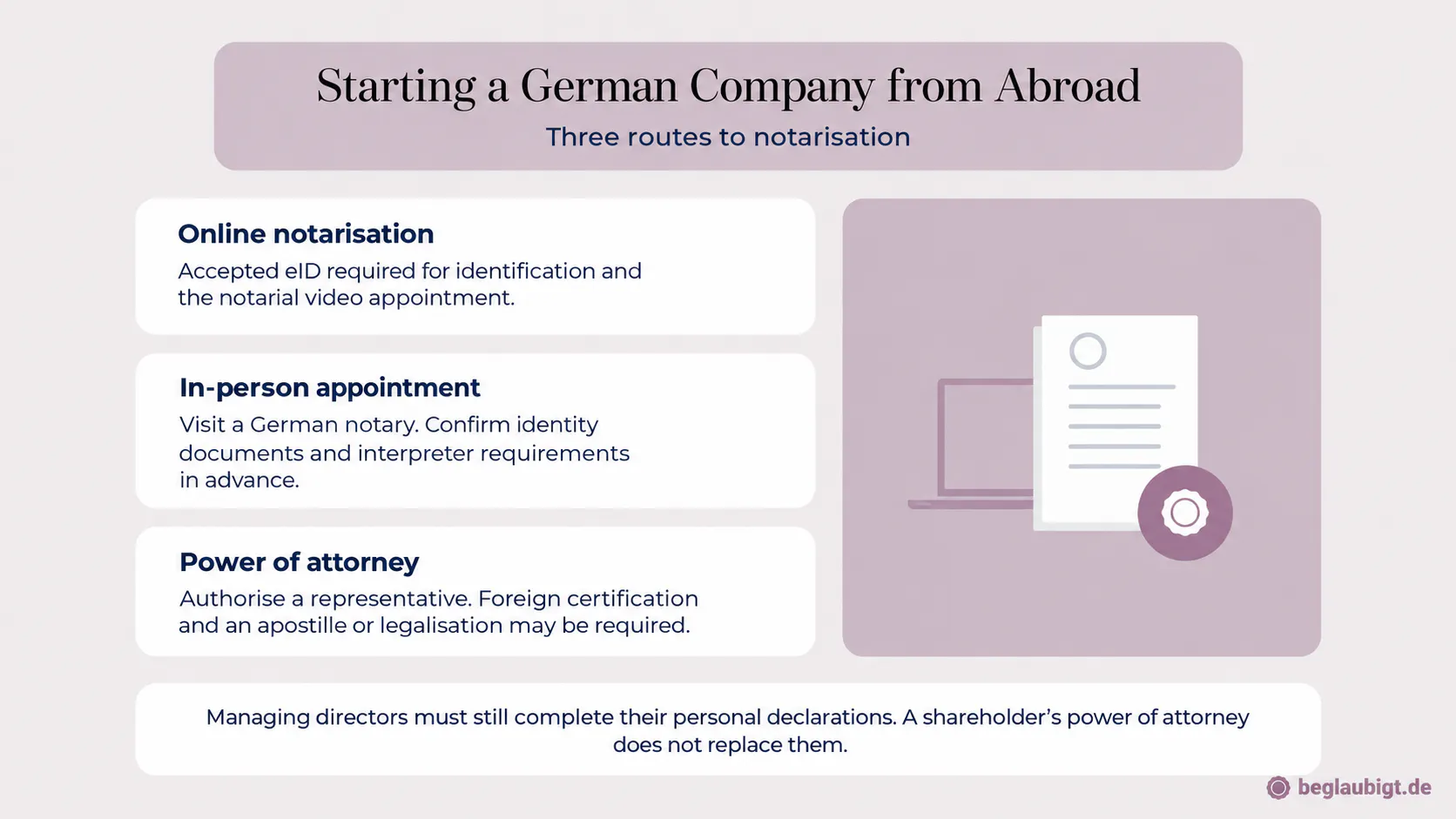
- Alternatives include attending a German notary in person or using a properly authenticated incorporation power of attorney. The managing director’s personal declarations must still be handled separately.
- Banking, foreign documents and tax registration need their own preparation. An apostille does not replace a translation, and a company registration number is not a tax number.
With beglaubigt.de’s GmbH formation service, you can prepare and coordinate your incorporation. Clarify your country of residence, identity documents and shareholder structure before choosing the online or in-person route.
- Can a non-resident own and manage a German GmbH or UG?
Foreign shareholders can generally establish a German company
German company formation is generally open to shareholders living abroad. You do not normally need German citizenship or a German home address to hold shares in a GmbH or UG. Depending on the structure, the shareholder can also be a foreign company rather than an individual.
The distinction between owning a company and personally working in Germany matters. Becoming a shareholder does not automatically give you permission to move to Germany or carry out activities there that require immigration authorisation. If relocation is part of your plan, assess the relevant residence and work requirements alongside incorporation. Certain business activities may also require sector-specific licences.
For a closer look at international ownership structures, see our German-language guide to forming a GmbH with foreign shareholders.
Does the managing director have to live in Germany?
A GmbH or UG managing director does not generally have to reside in Germany. Living abroad does not, by itself, prevent appointment. The individual must nevertheless meet the statutory eligibility requirements and be able to fulfil the responsibilities of the role.
Those responsibilities continue regardless of location. A director needs reliable access to company information, must organise compliance and must ensure official correspondence receives timely attention. Appointing someone who lives abroad does not reduce the director’s obligations.
There is also a separate tax question: where is the company actually managed? Decisions made consistently from another country can create cross-border tax issues. A German registered address does not settle that question. [1] [16]
- What German address does the company need?
Registered seat and business address serve different purposes
A GmbH or UG must have its statutory registered seat in Germany under § 4a GmbHG. Its commercial register application must also state a domestic business address under § 8(4) GmbHG.
The registered seat identifies the municipality specified in the articles of association. The business address identifies the location where the company can receive official communications. Neither requirement means that the managing director must personally live at that address.
For founders abroad, the practical issue is dependable delivery. Someone must receive important correspondence and make it available promptly. A missed court letter or tax-office request can interrupt incorporation or create problems after registration. [2] [3]
Does a virtual business address solve everything?
An address service may be suitable, but its suitability depends on the arrangement and intended use. Before committing, establish whether the company may use the address for commercial registration, how formal service of documents is handled and how quickly correspondence reaches you.
The register court, tax office and bank assess different matters. A bank may ask about the operating location and commercial connection to Germany. The tax office may need to understand where management and business activities actually occur. An address contract alone does not answer those questions.
The beglaubigt.de business address service is a relevant starting point when organising a German address. Check the intended use against your company’s circumstances. Our guide to what makes a German business address suitable for official service explains the underlying requirements.
- Should a non-resident choose a GmbH or UG?
A GmbH requires more share capital
A GmbH has a minimum share capital of €25,000. For a straightforward formation with cash contributions, registration can generally proceed once at least one quarter of each cash contribution and at least €12,500 overall have been paid. The unpaid balance remains an obligation; it is not waived.
Share capital is company funding rather than a formation-service fee. Keep it separate from notarial fees, court fees and the costs of authentication, translation or professional advice when preparing your budget. [4] [5]
A UG reduces the capital threshold, not the administrative requirements
A UG (haftungsbeschränkt) can be established with share capital below €25,000, theoretically starting at €1. Its agreed capital must be paid in full before registration, and contributions in kind are excluded at formation. The company must also allocate part of its annual profit to a statutory reserve under § 5a GmbHG.
Choosing a UG does not remove the need for a notary, business address, banking checks or tax registration. A very low capital amount also needs to be considered against the company’s actual expenses. International document preparation can create costs before the business generates revenue, so capital should reflect the business plan rather than only the legal minimum. [6]
- Can you incorporate online from abroad?
Online notarisation requires an accepted electronic identity document
German law permits online notarisation for eligible GmbH and UG formations. The procedure takes place through the Federal Chamber of Notaries’ authorised system and includes prescribed identification steps.
A biometric passport is not automatically sufficient. Reading a passport photograph and authenticating someone through an accepted electronic identity function are separate requirements. Depending on the document, an additional passport may be needed for the photograph.
Accepted identification can include a German identity card with activated online ID, an eligible electronic residence permit or another supported electronic identity document. EU and EEA citizens may also be able to obtain the German eID card for Union citizens. Eligibility should be checked against the current official document list.
You will normally also need the relevant PIN, an NFC-capable smartphone with the Notary App, a suitable device for the video appointment and a stable connection. Test identification before scheduling the appointment. [7]
Digital preparation and online notarisation are different
You may be able to submit information, review drafts and coordinate your incorporation digitally even if you cannot use online notarisation. The decisive question is whether every required participant can complete the applicable identification and signing steps.
With beglaubigt.de’s formation process, preparation and coordination can take place digitally. The notarial act itself is performed by an independent notary, either through the legally permitted online procedure or at an in-person appointment.
- What alternatives exist if you do not have a suitable eID?
Option 1: Attend a notary in Germany
An in-person appointment avoids the electronic identification requirements of online notarisation. The notary still needs acceptable identity documents and all information necessary to prepare and complete the transaction.
Arrange the appointment before booking travel. Explain who will attend, whether any shareholder is a foreign company and which languages the participants understand. The notary can then clarify document and interpreter requirements in advance.
For some founders, a planned visit is more practical than obtaining several documents abroad. That is a scheduling decision: compare travel with the authentication, translation and delivery steps your alternative would require.
Option 2: Use an incorporation power of attorney from abroad
A shareholder can generally authorise a representative to sign the incorporation documents. Under § 2(2) GmbHG, the power of attorney must be notarised or have the signature notarially certified.
Where it is executed abroad, the German notary should approve the wording and proposed certification procedure beforehand. Depending on the issuing country and applicable rules, an apostille, legalisation or another form of authentication may be necessary.
An apostille does not correct an unsuitable power of attorney. It authenticates the relevant signature, official capacity and seal; it does not establish that the representative has every authority required for your incorporation. [8] [9]
The managing director must still complete personal formalities
A shareholder’s incorporation power of attorney does not replace the managing director’s personal statutory declarations. The formation application includes assurances concerning matters such as eligibility and capital contributions under § 8 GmbHG.
If you will be both shareholder and managing director, ask the German notary how your own declarations and signature will be handled. Depending on the circumstances, this may involve an eligible online procedure, an appointment in Germany or an appropriate certification route abroad.
The practical implication is simple: a power of attorney can enable representation at incorporation, but it does not automatically make the entire process travel-free. [3]
- Which foreign documents need an apostille, legalisation or translation?
Establish what each document must prove
Requirements depend on the person or organisation involved. An individual shareholder and a foreign corporate shareholder will not necessarily provide the same evidence.
For a foreign company, the German notary may need documents establishing its existence and showing who may represent it. These can include register extracts, constitutional documents and evidence of signing authority. A document proving that a company exists may not, by itself, prove that the person signing has authority to bind it.
Before ordering documents, send the notary a description of the ownership structure and the available evidence. Agree the required documents, acceptable age, certification and delivery format as one coordinated request. [18]
Apostille and legalisation are different authentication routes
An apostille can replace legalisation where the Hague Apostille Convention applies between the relevant states and covers the document. It is normally issued by a competent authority in the country of origin.
Where the Convention does not apply and no exemption exists, legalisation through a German diplomatic mission may be relevant. Some countries require other verification procedures. Check the current position for the document and issuing country rather than assuming one route applies worldwide.
The Apostille Convention information maintained by the Hague Conference is the reference point for participating states and competent authorities. Our German-language apostille or legalisation country guide provides additional orientation. [9] [10]
A translation is a separate requirement
Authentication and translation solve different problems. Authentication concerns a document’s origin; translation makes its content accessible in another language. Neither automatically replaces the other.
Clarify whether the notary or register court requires a German translation and which translator qualifications it accepts. The Federal Foreign Office recommends sworn or certified translators in Germany where German authorities or courts require translations. EU origin alone should not be treated as a blanket exemption for corporate documents. [9]
- How do non-residents open a business bank account?
Check eligibility before it becomes the bottleneck
Non-resident ownership does not mean every bank will accept the company. Institutions apply their own onboarding criteria alongside legal duties to identify customers, representatives and beneficial owners.
Explain the proposed structure early: where directors and owners live, what the company will do, where customers are located and which countries payments will involve. Ask whether the institution supports a GmbH i.G. or UG i.G., meaning a company in formation, so the capital contribution can be organised before registration.
Possible requests include identity and residential-address evidence, incorporation documents, ownership charts and explanations of business activity or funding. The exact requirements depend on the institution and risk assessment. [11]
Notarial identification does not guarantee bank approval
A successful notarial appointment does not complete the bank’s own checks. Likewise, a German business address does not guarantee that the institution will accept directors or beneficial owners resident abroad.
Plan banking and incorporation together. Ask when account details become available, how capital payments should be made and what evidence will be supplied for the registration process. This helps avoid a gap between signing the incorporation documents and being able to fund the company.
If an account application is declined, establish the reason before submitting another. A missing document requires a different response from a bank that does not support the relevant residence country or business activity.
- How do tax registration, the Steuernummer and VAT ID work?
The new company needs its own tax registration
The Steuernummer is the tax number allocated by the responsible German tax office. A newly formed GmbH or UG generally submits the relevant tax-registration questionnaire electronically, normally through ELSTER.
The questionnaire covers matters such as the company’s activities, management, expected turnover and VAT treatment. A founder living abroad should distinguish their own personal tax information from the new company’s registration. The company’s tax number is also separate from its commercial register number.
Relevant notifications and information under § 138 AO are generally subject to a one-month deadline after the reportable event. Agree the applicable starting point with your adviser rather than waiting indefinitely for another administrative step to finish. [12] [13]
The USt-IdNr. is a separate VAT identification number

The Umsatzsteuer-Identifikationsnummer, or USt-IdNr., is issued by the Federal Central Tax Office. It is distinct from the Steuernummer and is particularly relevant to transactions within the EU.
A new company can request a VAT ID through its tax-registration questionnaire. Providing the necessary information early helps avoid having to start a separate request once cross-border trading is about to begin.
Do not confuse a German company with foreign shareholders with an existing foreign business registering for German VAT. Those are different situations. If a foreign parent will also trade directly in Germany, its obligations need to be considered separately. [13] [14]
Management from abroad can create additional tax questions
Under § 1 KStG, a corporation with its registered seat or management in Germany generally falls within unlimited German corporate income tax liability. Operating from abroad may also create obligations in another country.
The place of management concerns the actual centre of business direction under § 10 AO. If you will run the company from your home country, assess the relevant domestic rules and tax treaty before deciding how management will work. Incorporation documents alone cannot resolve questions about where decisions are actually made. [15] [16]
- Could a German branch be an alternative?
A branch remains part of the foreign company
If you already operate through a foreign company, a German branch may be an alternative to forming a separate GmbH or UG. An autonomous branch, a selbständige Zweigniederlassung, can conduct business with organisational independence while remaining legally part of the foreign enterprise.
The foreign company remains liable for the branch’s transactions. An autonomous branch generally requires commercial register registration involving a German notary, together with local trade registration. Evidence of the foreign company’s existence and representation is needed.
A dependent establishment has a different registration profile and should not be confused with an autonomous branch. [17]
Choose based on the operating model
A branch may suit a business that wants to expand an existing foreign operation. A separate subsidiary may better fit plans involving separate ownership, investment or contractual relationships.
The comparison should include liability, accounting, tax treatment and the documents required in both countries. A branch avoids forming a separate German corporation, but it does not eliminate German administrative or tax obligations. Its treatment as a permanent establishment also needs assessment. [17]
- What does the formation process look like in practice?
Step 1: Confirm the structure and signing route
Decide who will own the company, who will manage it and whether the shareholders are individuals or companies. Then check electronic identification eligibility for everyone who needs to participate.
If online notarisation is unavailable, choose between an in-person appointment and representation under a power of attorney. Resolve the managing director’s personal formalities at the same time. This prevents the incorporation appointment from being organised around an incomplete signing plan.
Step 2: Coordinate the address, documents and bank application
Prepare these elements together. An address should match the intended use, foreign documents should follow the notary’s instructions and the bank should understand the ownership and management structure.
Create one agreed record of names, addresses, company details and ownership percentages. Use it consistently across drafts, bank applications and tax information. Small inconsistencies can otherwise lead to avoidable clarification requests.
Step 3: Complete notarisation, capital funding and registration
The articles of association require notarisation. Once the relevant capital requirements and other registration conditions are met, the notary handles submission to the commercial register.
Keep the stages distinct. A notarial appointment, capital payment and completed registration are separate milestones. The company should not assume that notarisation alone means its incorporation has been completed. [5] [8]
Step 4: Finish the operational registrations
Plan trade registration, tax registration and beneficial-ownership reporting alongside incorporation. Depending on the business, further permits or employment-related registrations may apply.
Assign responsibility for each task before the notarial appointment. Record who will submit it, which information is still needed and where incoming correspondence will be received. For someone managing the process across borders, this is often more useful than a target date that overlooks the dependencies.
- How long does formation take, and what should you budget?
The timeline depends on more than the notarial appointment
There is no reliable universal completion time for non-resident formations. The available identification route, foreign documents, bank onboarding and register-court processing all influence the schedule.
A straightforward case with accepted identification and complete documents has fewer dependencies than one involving a foreign corporate shareholder and authenticated powers of attorney. Neither should be planned solely around how quickly an appointment is available.
For planning purposes, separate preparation, notarisation, capital funding, registration and tax administration. Our German-language guide to GmbH formation timelines and common delays explains these stages.
Keep the different cost categories visible
Your budget should distinguish share capital from service and administrative costs. Alongside notarial and register fees, international cases may involve foreign certification, authentication, translations, document delivery, travel and tax advice.
As of 15 October 2026, beglaubigt.de advertises formation packages starting at €249 plus VAT. This is the price for its services; notarial costs and commercial register fees are additional. International document work and other services should be confirmed for the individual case. [19]
- Your next step with beglaubigt.de
Prepare your German company formation from abroad
The most useful starting point is a clear description of your situation: your country of residence, nationality, available identity documents, proposed shareholders and intended managing directors. This information helps establish which formation route needs to be prepared.
With beglaubigt.de, you can organise the preparation and coordination of your GmbH or UG formation, including the notarial stage and commercial register application. The independent notary performs the notarisation, while the register court decides on registration.
Start your German company with a clear plan
Formation services from €249 plus VAT. Notarial costs and commercial register fees are additional.
Want to move towards a notarial appointment within seven working days? Ask which route fits your documents and availability. Foreign authentication, banking and register processing can extend the overall timeline. Explore beglaubigt.de formation packages
FAQ: Setting up a GmbH or UG in Germany as a non-resident
Can I own 100% of a German GmbH while living abroad?
Generally, yes. Residence abroad does not normally prevent sole ownership. Identity checks, beneficial-ownership requirements and any restrictions relevant to the business still apply. Ownership also does not automatically grant German residence or work rights.
Do I need a managing director who lives in Germany?
There is generally no requirement to appoint a director solely because that person lives in Germany. The appointed director must be eligible and able to fulfil the role. Managing the company from abroad should also be assessed for cross-border tax consequences.
Is my biometric passport enough for online formation?
Not necessarily. The online procedure requires an accepted electronic identity method, and the passport may serve a separate photograph-reading function. Check the official supported-document requirements before booking an online appointment.
Can I form the company without travelling to Germany?
Potentially. An eligible online procedure or a properly prepared representation arrangement may allow this. However, the managing director’s personal declarations and bank identification must also be resolved. A shareholder power of attorney alone does not guarantee a completely remote process.
Does every foreign document need an apostille?
No. The answer depends on the issuing country, document and applicable agreements. Some documents may be exempt; others may require an apostille, legalisation or another verification procedure. Confirm the route before obtaining certification.
Does a German business address guarantee a business bank account?
No. Banks assess the company, its representatives, beneficial owners and activities independently. They may have residence-country restrictions or request information beyond what the register court requires.
Are the Steuernummer and VAT ID the same?
No. The Steuernummer is allocated by the responsible tax office. The USt-IdNr. is a separate VAT identification number issued by the Federal Central Tax Office. Neither is the company’s commercial register number.
Is forming a UG simpler for someone living abroad?
A UG has a lower share-capital threshold, but the central identification, notarisation, address, banking and tax-registration issues remain. Choose it based on the company’s funding and business needs rather than expecting it to bypass international formation requirements.
Sources
[1] Federal Government’s Business Start-up Portal – GmbH formation while living abroad
[2] § 4a GmbHG – Registered seat
[3] § 8 GmbHG – Contents of the commercial register application
[4] § 5 GmbHG – Share capital and shares
[5] § 7 GmbHG – Application for registration and capital contributions
[6] § 5a GmbHG – Unternehmergesellschaft (haftungsbeschränkt)
[7] Federal Chamber of Notaries – Online notarisation: technical requirements and identity documents
[8] § 2 GmbHG – Form of the articles and incorporation powers of attorney
[9] Federal Foreign Office – Foreign public documents for use in Germany
[10] Hague Conference – Apostille Convention, participating states and competent authorities
[11] § 10 GwG – Customer due diligence requirements
[12] § 138 AO – Business notifications and tax information
[13] ELSTER – Tax-registration questionnaire for corporations
[14] Federal Administrative Portal – Applying for a VAT identification number
[15] § 1 KStG – Unlimited corporate income tax liability
[16] § 10 AO – Place of management
[17] Germany Trade & Invest – Branch offices
[18] Germany Trade & Invest – Company set-up in Germany
[19] beglaubigt.de – Formation packages, service scope and prices